María Begoña Zalba Etayo1 ID· Eva De Diego-García1 ID· Héctor Mercado-Castillo1 ID· José Luis Cabrerizo-García2 ID
1Unidad de Cuidados Intensivos del Hospital Clínico Universitario Lozano Blesa de
Zaragoza.
2Profesor Asociado Universidad de Zaragoza. Servicio Medicina Interna del
Hospital Clínico Universitario Lozano Blesa de Zaragoza.
España.
Acta Gastroenterol Latinoam 2026;56(3):332-341
Received: 10/03/2026 / Accepted: 03/09/2026 / Published online: 30/09/2026 / https://doi.org/10.52787/agl.v56i3.616
Introduction. Patients with chronic liver disease are at increased risk of developing infections and sepsis. Although high mortality in this context is well documented, the prognostic factors associated with poorer survival in patients admitted to the ICU have not been fully defined. Objective. To describe the characteristics of critically ill patients with chronic liver disease and sepsis, to determine mortality, and to analyze the factors associated with a poorer prognosis. Methods. An observational, retrospective, descriptive and analytical study of a cohort of patients with chronic liver disease and a diagnosis of sepsis admitted to the ICU at the Hospital Clínico Universitario Lozano Blesa, in Zaragoza, Spain, between 2012 and 2023. Results. A total of 71 patients were included, 69% were male, and 51% had alcohol-related liver disease. In the bivariate analysis, higher Child-Pugh and MELD scores at admission, elevated bilirubin and INR levels, as well as the type of infection, were associated with a poorer prognosis. The ICU mortality rate was 54.9%. Independent predictors of mortality were a higher MELD score at admission (OR: 1.21; 95% CI: 1.02–1.45), Gram-positive bacterial infection (OR: 7.58; 95% CI: 1.95–29.50), and fungal infection (OR: 7.36; 95% CI: 2.10–25.75). Conclusion. Sepsis in patients with chronic liver disease is associated with high mortality. A higher MELD score at admission and the presence of Gram-positive bacterial or fungal infections were identified as independent prognostic factors for death.
Keywords. Chronic liver disease, sepsis, mortality, MELD score.
Introducción. Los pacientes con hepatopatía crónica presentan una susceptibilidad mayor para desarrollar infecciones y sepsis. Aunque la elevada mortalidad en este contexto está bien documentada, no están completamente definidos los factores pronósticos asociados a la menor supervivencia en aquellos pacientes ingresados en UCI. Objetivos. Describir las características de los pacientes con hepatopatía crónica y sepsis en estado crítico, determinar la mortalidad y analizar los factores asociados a un peor pronóstico. Métodos. Estudio observacional, retrospectivo, descriptivo y analítico de una cohorte de pacientes con hepatopatía crónica y diagnóstico de sepsis ingresados en la UCI del Hospital Clínico Universitario Lozano Blesa de Zaragoza entre los años 2012-2023. Resultados. Fueron incluidos un total de 71 pacientes; el 69% eran varones y el 51% presentaba hepatopatía de origen alcohólico. En el análisis bivariado se asociaron con un peor pronóstico las puntuaciones elevadas en las escalas Child-Pugh y MELD al ingreso, las cifras elevadas de bilirrubina e INR, y el tipo de infección. La tasa de mortalidad en UCI fue del 54,9%. Los predictores independientes de mortalidad fueron una mayor puntuación MELD al ingreso (OR: 1,21; IC 95%: 1,02–1,45), infección por bacterias Gram positivas (OR: 7,58; IC 95%: 1,95–29,50) y la infección fúngica (OR: 7,36; IC 95%: 2,10–25,75). Conclusión. La sepsis en pacientes con hepatopatía crónica se asocia con una alta mortalidad. Se identificaron como factores pronósticos independientes de mortalidad una mayor puntuación MELD al ingreso y la presencia de infecciones por bacterias Gram positivas o por hongos.
Palabras claves. Hepatopatía crónica, sepsis, mortalidad, escala MELD.
Abbreviations
INR: International normalized ratio.
ICU: Intensive care unit.
MELD: Model
for End-Stage Liver Disease.
OR: Odds ratio.
CLD: Chronic liver
disease.
NAFLD: Non-alcoholic fatty liver disease.
qSOFA: quick Sequential Organ
Failure Assessment.
APACHE II: Acute Physiology and Chronic Health Evaluation
II.
CEICA: Committee for Research of the Autonomous Community of Aragón.
SD:
Standard deviation.
SBP: Spontaneous bacterial peritonitis.
Chronic liver disease (CLD) encompasses a spectrum of hepatic disorders characterized by progressive destruction of the liver parenchyma, which can ultimately lead to cirrhosis and liver failure. The main causes include chronic viral hepatitis (types B and C), excessive alcohol consumption, and non-alcoholic fatty liver disease (NAFLD), which is closely associated with obesity and type 2 diabetes mellitus. Autoimmune, metabolic, and genetic disorders may also contribute to the development of the disease.1, 2
It is estimated that more than 350 million people worldwide suffer from chronic hepatitis B or C, while NAFLD affects approximately 25% of the global population, a figure which continues to rise in parallel with increasing rates of obesity and metabolic syndrome. In Spain, NAFLD is currently the leading cause of chronic liver disease, affecting 30-40% of the adult population. Conversely, the prevalence of hepatitis C has declined due to therapeutic advances, and hepatitis B incidence has markedly decreased through systematic vaccination programs.
Complications arising from chronic liver disease impose a significant burden on healthcare systems due to the high rates of hospitalization and the need for specialized management in advanced stages characterized by necrosis and fibrosis. These pathophysiological changes contribute to the development of portal hypertension and progressive hepatic dysfunction.2 – 4 Within this context, infections are one of the principal causes of hospital and ICU admission, with a reported prevalence of 30–50%, either at admission or during hospitalization.5 Numerous studies have shown that patients with advanced cirrhosis are at a much higher risk of bacterial infection than the general population.6 – 8 This significantly increases mortality.9 – 12
Patients with advanced liver disease exhibit profound immunosuppression, a condition known as cirrhosis-associated immune dysfunction syndrome. This syndrome involves alterations in both humoral and cellular immunity. The condition increases the risk of bacterial translocation from the intestine and therefore of infections such as spontaneous bacterial peritonitis (SBP), pneumonia, urinary tract infections, and bacteremia.13
The liver plays a central role in the systemic response to sepsis, contributing to the clearance of pathogens and toxins, cytokine production, and coagulation regulation. In cirrhotic patients, however, hepatic dysfunction can severely compromise these mechanisms, facilitating the systemic dissemination of microorganisms, uncontrolled inflammatory responses, and the development of multiple organ failure.5, 14 Additional predisposing factors include the prolonged use of proton pump inhibitors, frequent invasive procedures, recurrent hospitalizations, malnutrition, and excessive alcohol consumption.13, 15
The diagnosis of sepsis in cirrhotic patients can be challenging due to atypical or masked clinical manifestations intrinsic to liver disease. These include baseline hypotension, tachypnea secondary to ascites, altered lactate metabolism, hepatic encephalopathy, or leukopenia resulting from hypersplenism.16
The objective of this study was to describe the clinical characteristics of patients with chronic liver disease and severe sepsis, determine the associated mortality rate, and identify prognostic factors that are associated with an increased mortality risk.
This retrospective analytical-descriptive observational study was conducted at the Lozano Blesa University Clinical Hospital (Zaragoza, Spain), and included 71 patients with chronic liver disease and sepsis who were admitted to the ICU between January 1, 2012, and November 1, 2023. Sepsis was defined according to the Sepsis-3 criteria as a suspected or confirmed infection associated with an acute increase in the SOFA score of ≥ 2 points from baseline. To uniformly apply this same definition across the entire cohort, cases from the 2012–2016 period were retrospectively reviewed.
As this was a retrospective observational study, no prior sample size calculation was performed and all consecutive eligible patients were included.
The 71 included patients had chronic liver disease and sepsis. Six (8.5%) were diagnosed before ICU admission, and 65 (91.5%) were diagnosed in the ICU. Due to the limited size of the first subgroup and the absence of significant differences in key variables in exploratory analyses, they were analyzed together.
Patients were included if they met at least one of the following criteria: a confirmed diagnosis of chronic liver disease and admission to the ICU due to sepsis; or chronic liver disease and the development of sepsis of any etiology during their ICU stay. Patients who underwent liver transplantation during their ICU stay and patients with an ICU stay of less than 24 hours were excluded.
The recorded variables included demographic variables: age, sex, toxic habits (e.g. alcohol and tobacco use), and presence of comorbidities; clinical and hospitalization data: date and reason for admission, referring department, and length of ICU stay; and clinical and laboratory variables: etiology of liver disease, source of sepsis, renal and hepatic function tests, complete blood count, arterial blood gas analysis, and coagulation parameters. These were all obtained within the first 24–48 hours after ICU admission. Microbiological data included the results of urine cultures, blood cultures, bronchoaspirates, and catheter tip cultures. The recorded prognostic scores were Child-Pugh score, the MELD (Model for End-Stage Liver Disease) score, the qSOFA (quick Sequential Organ Failure Assessment) score, and the APACHE II (Acute Physiology and Chronic Health Evaluation II) score.
Statistical Analysis
Categorical variables are expressed as absolute frequencies and percentages, and continuous variables as mean and standard deviation (SD), according to their distribution. For the bivariate analysis of factors associated with ICU mortality, deceased and surviving patients were compared. Continuous variables were analyzed using the independent samples Student’s t-test (or Mann-Whitney U test if not normally distributed), and categorical variables using the Pearson Chi-square test (or Fisher’s exact test when expected frequencies were < 5). A multivariate logistic regression analysis (enter method) was performed to identify independent predictors of ICU mortality.
The discriminative ability of prognostic scores (MELD and Child-Pugh) for predicting ICU mortality was evaluated using Receiver Operating Characteristic (ROC) curves, and the Area Under the Curve (AUC) was calculated with its 95% CI.
ICU survival was estimated using the Kaplan-Meier method, and survival curves were compared across MELD score strata using the Log-rank test.
All tests were two-tailed, and a p-value < 0.05 was considered statistically significant. Statistical analyses were performed using the Statistical Package for the Social Sciences, version 25.0 (IBM Corp., Armonk, NY, USA).
Ethical Considerations
The study was designed in accordance with the recommendations of the Declaration of Helsinki for biomedical research involving human subjects. Approval for the project was granted by the Ethics Committee for Research of the Autonomous Community of Aragón (CEICA) on December 21 2023.
The study sample included a total of 71 patients, of whom 49 were men (69.0%) and 22 were women (31.0%). The mean age was 59.3 years (SD 8.5), with most patients being younger than 60 years. The most common comorbidities were dyslipidemia (present in 18 patients, 25.4%), arterial hypertension (present in 16 patients, 22.5%), and diabetes mellitus (present in 15 patients, 21.1%). Associated diseases identified included cardiac disorders in 13 patients (18.3%), neuropathies in in eight patients (11.3%), and pulmonary disease in seven patients (9.9%). A high prevalence of alcohol and tobacco use was observed. Harmful alcohol consumption was reported in 32 patients (45.1%), while 21 patients (29.6%) had discontinued alcohol use, representing over two-thirds of the study population. In addition, 26 patients (36.6%) were active smokers, while two (2.8%) were former smokers.
The most frequent reason for ICU admission was gastrointestinal bleeding, observed in 26 patients
(36.6%).This was followed by edematous-ascitic decompensation in 21 patients (29.6%), hepatic encephalopathy in
14 patients (19.7%), and sepsis at admission in six patients (8.5%). Less frequent causes include hepatorenal
syndrome in three patients (4.2%) and acute-on-chronic liver failure in two patients (2.8%). The median ICU
length of stay was eight days (maximum 55 days).
On admission, the mean APACHE II score was 22.1 (SD 6.9),
the mean MELD score was 13.6 (SD 4.3), and the mean qSOFA score was 1.2 (SD 0.8). According to the Child-Pugh
classification, most patients were classified as Child-Pugh B (n = 52; 73.2%), followed by Child-Pugh C (n = 18;
25.4%) and Child-Pugh A (n = 1; 1.4%).
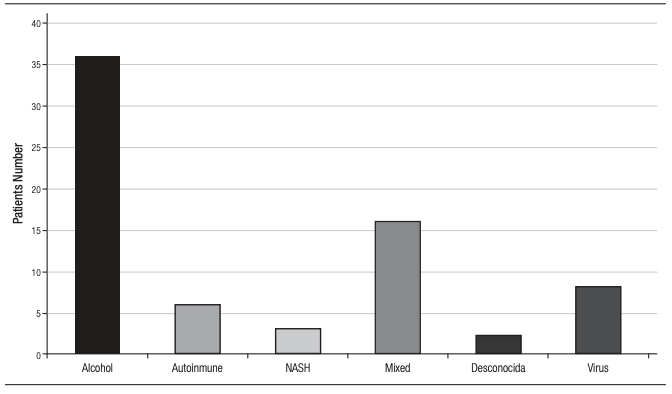
The most common cause of chronic liver disease was alcohol-related cirrhosis, identified in 36 patients (50.7%). Other etiologies included mixed causes in 16 patients (22.5%), viral hepatitis in eight patients (11.3%), autoimmune liver disease in six patients (8.5%), NAFLD in three patients (4.2%), and unknown etiology in two patients (2.8%) (Figure 1).
Figure 1. Etiology of Chronic Live Disease
Regarding the source of sepsis, pneumonia and bacteremia were the most common, affecting 20 patients (28.2%) each. Urinary tract infection was diagnosed in 18 cases (25.4%), and spontaneous bacterial peritonitis in seven patients (9.9%). Soft tissue infections and cholangitis were less frequent, occurring in four patients (5.6%) and one patient (1.4%), respectively.
Infections were predominantly bacterial, with Gram-negative bacteria isolated in 34 patients (47.9%) and Gram-positive bacteria in 24 (33.8%). Fungal infections were also relevant, detected in 24 patients (33.8%), whereas viral infections were identified in only four patients (5.6%). Some patients presented more than one microorganism isolated from various culture sites, including blood, urine, bronchial aspirate, and peritoneal fluid. In 10 patients with clinical and laboratory evidence of infection, microbiological isolation was not achieved. Overall, a positive culture was obtained in 85.9% of cases.
The most frequent Gram-negative microorganisms were Escherichia coli in 15 cases (23.8%), Enterobacter spp. in 5 (7.9%), Pseudomonas spp. in 8 (12.7%), and Klebsiella spp. in 4 (6.3%). Among Gram-positive bacteria, Staphylococcus epidermidis was found in nine cases (14.3%), which is considered clinically significant if isolated in at least two blood culture sets. This was followed by Enterococcus faecium in eight cases (12.7%), Enterococcus faecalis in two cases (3.2%), and Staphylococcus aureus in three cases (4.8%). Active fungal screening was conducted in all cases. Candida albicans was identified in 21 patients (34.4% of positive cultures) and Aspergillus spp. in three patients (4.9%). In 10 patients with clinical signs of infection, all cultures were negative. (Figure 2).
Figure 2. Sample Distribution Based on Culture Results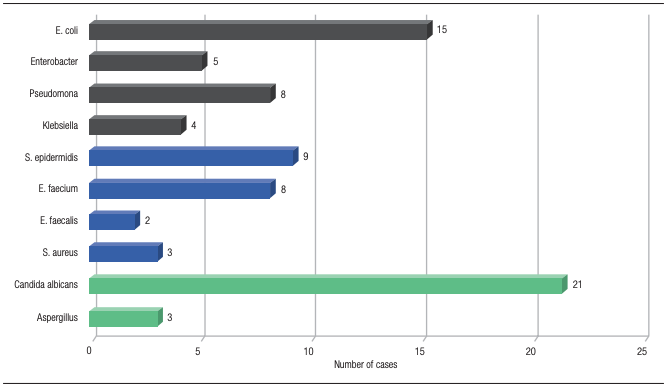
Of the 71 patients diagnosed with chronic liver disease and sepsis, 39 (54.9%) died in the ICU, while 32 (45.1%) survived. Overall mortality was 71.8% at six months and 76.1% at 12 months.
A bivariate analysis comparing deceased (n = 39) and surviving (n = 32) patients revealed no significant differences in mean age (58 vs. 60 years) or sex distribution (27 men and 12 women among the deceased vs. 22 men and 10 women among the survivors). However, prognostic scores were significantly higher among deceased patients. Statistically significant differences were found in Child–Pugh (p = 0.05) and MELD (p = 0.004) scores. The mean MELD score was 14.86 for deceased patients versus 11.88 for survivors. Moreover, a higher proportion of Child–Pugh C patients was observed among the deceased (14 patients; 35.8%) compared with survivors (four patients; 12.5%).
Significant differences were also observed in INR (p = 0.037) and bilirubin (p < 0.001) levels, which were both higher in deceased patients. There were no significant differences in leukocyte count (p = 0.796), hematocrit (p = 0.094), platelet count (p = 0.561), creatinine (p = 0.315), albumin (p = 0.720), or sodium (p = 0.449) levels between the two groups (Table 1). Pneumonia and bacteriemia were the most frequent infections among those who died. Infections caused by Gram-positive bacteria and fungi were significantly associated with higher mortality (p = 0.015 and p = 0.003, respectively), whereas Gram-negative infections were not significantly related to mortality (p = 0.424) (Table 2).
Table 1. Comparison of clinical and analytical data at ICU admission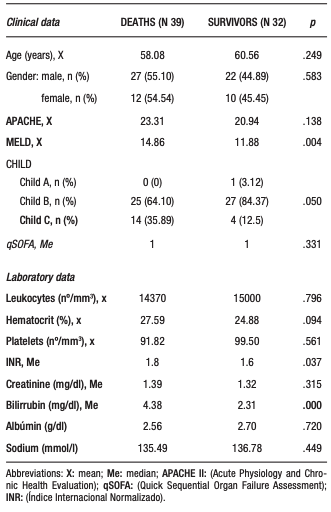
Table 2. Comparison of infection type and culture results between both groups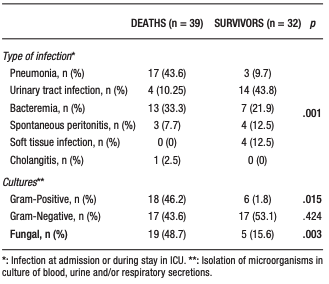
Multivariate logistic regression analysis, which included the MELD score at admission, Gram-positive bacterial infection, and fungal infection, showed adequate calibration (Hosmer–Lemeshow χ² = 3.643; df = 8; p = 0.888). After adjustment, the following variables were found to be independently associated with ICU mortality: MELD score at admission (OR = 1.21; 95% CI: 1.02–1.45; p = 0.03), Gram-positive bacterial infection (OR = 7.58; 95% CI: 1.95–29.50; p = 0.003), and fungal infection (OR = 7.36; 95% CI: 2.10 – 25.75; p = 0.002).
The predictive analysis of the MELD and Child-Pugh scores showed respective areas under the curve (AUC) of 0.691 (95% CI: 0.56 – 0.81; p = 0.006) and 0.698 (95% CI: 0.57 – 0.82; p = 0.005). The optimal cut-off point was a MELD score ≥ 10.23, with a sensitivity of 51%, a specificity of 81%, and a Youden index of 0.325 (Figure 3). Likewise, the ICU survival curve showed higher mortality among patients with higher MELD scores (Figure 4, log-rank p = 0.002).
Figure 3. Survival according to the MELD scale and ChildPugh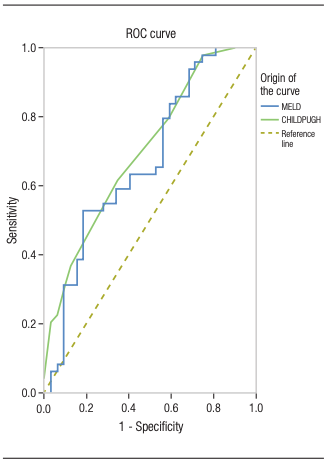
Figure 4. Long Rank and Survival Stratified by MELD at Admission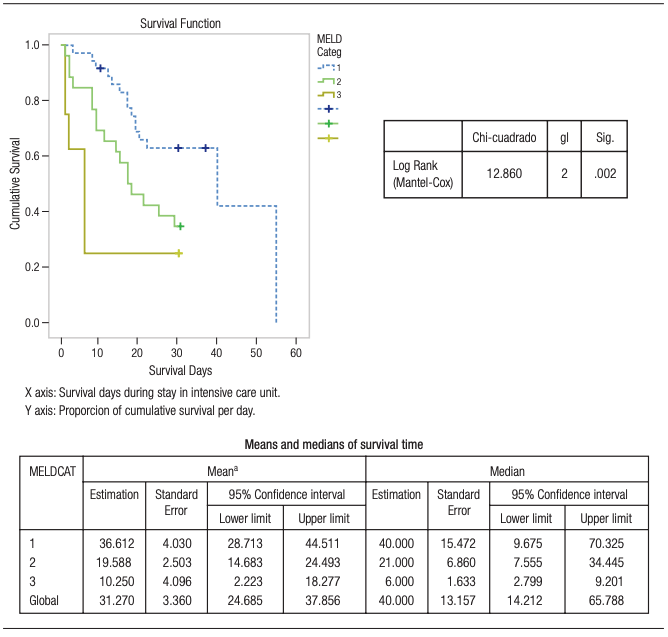
The present study highlights the negative prognostic impact of CLD in patients admitted to the ICU with sepsis, emphasizing the high mortality rate that characterizes cirrhotic patients, regardless of etiology. This elevated mortality rate reflects the severe complications faced by individuals with chronic liver disease, particularly those who develop sepsis during hospitalization.
Our findings should be interpreted in the context of the growing body of literature on critical care sepsis, including systematic reviews and meta-analyses that address major complications and outcomes (e.g., sepsis-associated ARDS) in broader ICU populations.17 However, these studies do not focus specifically on patients with advanced chronic liver disease, who are a distinct subgroup with different immune dysfunction, infection epidemiology, and organ-failure trajectories. Therefore, the main value of our work does not lie in its sample size, but in its contribution of detailed, real-world single-center data with comprehensive clinical and microbiological characterization. This data may help us to understand local epidemiology and inform empiric management strategies in comparable settings. In addition, our cohort includes a systematic assessment and reporting of fungal infections, an aspect that is not uniformly detailed in many series, and provides an outcome assessment beyond ICU discharge (at 6 and 12 months), offering a broader perspective on prognosis after the critical episode.
It is well established that patients with CLD are more susceptible to severe infections, which are associated with a marked increase in both short- and long-term mortality.8 – 12 This phenomenon is primarily related to alterations in host defense mechanisms against bacterial pathogens. Additionally, intestinal bacterial translocation is more frequent in these patients and further increases their vulnerability to infection, contributing to clinically significant complications such as SBP and/or bacteremia. Infection can trigger a systemic inflammatory response and sepsis, exacerbating the circulatory dysfunction inherent in advanced liver disease and increasing the risk of renal failure, hepatic encephalopathy and, ultimately, death. Similar associations between infection and adverse outcomes have also been reported in real-world Latin American cohorts.21
In our cohort, the most frequent infectious sources were pneumonia and bacteremia (28.2% each), followed by urinary tract infection (25.4%) and SBP (9.9%). These findings are consistent with previous studies in critically ill cirrhotic patients,10 – 12, 15, 18 although some reports describe SBP as the predominant source of infection, surpassing urinary and bloodstream infections.15, 19
Elevated INR and bilirubin values at admission were associated with worse prognosis and higher mortality, in agreement with previous studies.20 – 22 It has also been suggested that identifying plasma levels of von Willebrand factor, interleukin-10, 1-β, and 1-RA could help to determine which patients are most vulnerable to infection.23, 24 However, these novel biomarkers are not available in routine clinical practice, particularly in middle-income settings. This reinforces the clinical relevance of the conventional, universally available laboratory variables such as bilirubin and INR, identified in this cohort.
Regarding the etiology of liver disease in our cohort, alcohol-related cirrhosis was the most prevalent (50.7%),18, 19, 22 reflecting the high prevalence of harmful alcohol use in this population. However, in line with the global epidemic of obesity and metabolic disorders, recent studies have reported a progressive increase in non-alcoholic steatohepatitis (NASH) over the past decades.21 This epidemiologic shift may have important implications for prognosis and for future management strategies.
The poor outcomes of patients with chronic liver disease and septic shock are well documented.9 – 12, 18 – 20, 22 Nevertheless, mortality rates vary considerably across recent studies,9 – 12, 15 – 22 and the determining factors have not yet been fully defined. In our cohort, more than half of the patients (54.9%) died during their ICU stay, and over two-thirds within one year. This finding reinforces the strong association between severe sepsis and mortality among patients with chronic liver disease of any etiology. Our results are consistent with those reported by Baudry et al.,11 who found a mortality rate of 54% in a cohort of 149 cirrhotic patients admitted to the ICU with septic shock. However, other studies have reported even higher ICU mortality rates, ranging from 60% to 80%.9 – 12, 18, 19, 22 High mortality rates and their close relationship with disease severity have also been described in Latin American cohorts of ACLF and critically ill cirrhotic patients. This supports the external relevance of these findings across healthcare settings.28
Although Gram-negative bacteria are the most frequently reported etiologic agents of sepsis in cirrhotic patients18, 19, 25 in our series, infections caused by Gram-positive bacteria and fungi were independently associated with mortality. These infections increased the likelihood of death by more than sevenfold. In addition, Latin American data suggest that infections caused by multidrug-resistant bacteria in cirrhosis can significantly influence prognosis. This reinforces the importance of considering local microbiological ecology and resistance patterns when interpreting outcomes.29 Dionigi et al.10 compared mortality between infections caused by multidrug-resistant and non-resistant organisms and found no significant differences, underscoring the importance of microbiological characteristics in predicting outcomes.
The prognostic value of clinical scoring systems in this context is still a matter of
dabate. In our study, higher MELD scores were independently associated with increased mortality, which is
consistent with the findings of Ruíz et al.21 and Ahmed S,22 although this
association was not observed in other series.10, 11, 23 This is also consistent with ICU-based
Latin American experiences reporting a prognostic associations between baseline severity and mortality in
cirrhotic patients admitted to critical care.28 In parallel, hospital-based Latin American
studies have evaluated diagnostic criteria and prognostic scores in severe alcohol-related liver disease,
supporting the clinical usefulness of structured risk stratification tools in these settings.30
However, ROC curve analysis yielded moderate discriminative ability for both MELD and Child-Pugh scores,
with respective AUC values of 0.691 (95% CI 0.56 – 0.81) and 0.698 (95% CI 0.57 – 0.82). These findings
align with previous studies demonstrating that traditional liver-specific scores exhibit modest predictive
performance in critically ill cirrhotic patients, with reported AUC values frequently ranging between 0.60
and 0.75.5, 23
The optimal cutoff points identified in our cohort-MELD ≥ 10.23 and
Child-Pugh ≥ 9.5-demonstrated acceptable specificity but limited sensitivity, suggesting that while these
thresholds may help to identify high-risk patients, a substantial proportion of non-survivors would remain
undetected.5 Although ROC analysis identified an optimal cut-off of 10.23 in our specific cohort,
we chose to present Kaplan–Meier survival curves that are stratified using the universally validated MELD
thresholds (< 13, 13 – 19, > 19).26 These cut-offs represent the standard reference in
hepatology, ensure direct comparability with the existing literature, and avoid the overfitting inherent to
sample-derived (data-driven) thresholds.
The most recent literature suggests that the severity of liver disease alone is not a sufficient indicator of prognosis. Instead, the presence of sepsis appears to be the main driver of disease severity and mortality, particularly in patients who develop ACLF. In this context, Von Maldeghem et al.27 recently demonstrated that sepsis is a critical determinant of both severity and short-term mortality in ICU patients with alcohol-related cirrhosis and ACLF. Consistent with these observations, sepsis accounts for 20 – 50% of ICU admissions among patients with CLD and is an independent prognostic factor for mortality.20, 23, 25
There are several limitations of this study that warrant acknowledgment. Firstly, the retrospective, single-center design may have introduced inherent selection bias, restricting the generalizability of the findings to different clinical settings. Secondly, the modest sample size may have limited the statistical power to identify additional subtle prognostic determinants; furthermore, the lack of a control group precludes a direct comparison with other non-cirrhotic critically ill populations. Finally, while the pooled analysis of patients with sepsis upon admission (8.5%) and those developing it during their ICU stay (91.5%) was necessitated by the small size of the former subgroup and the absence of significant baseline differences, this approach might still introduce some degree of uncontrolled clinical heterogeneity.
In conclusion, among critically ill patients with chronic liver disease and sepsis, pneumonia and bacteremia were the most frequent and clinically relevant sources of infection. Higher bilirubin and INR levels at admission, as well as elevated MELD scores, were associated with poorer outcomes. In addition, infections caused by fungi and Gram-positive organisms emerged as independent predictors of mortality. Taken together, these findings highlight the importance of early recognition, prompt microbiological assessment, and timely treatment of infection in this high-risk population. There is also a need for intensive care strategies aimed at improving clinical outcomes.
Consent for publication. Written informed consent was obtained from the patients for participation and publication of this case.
Intellectual property. The authors declare that the data, figures and tables in this article are original and were carried out at their institutions.
Funding. The authors declare that there were no external sources of funding.
Conflict of interest. The authors declare that they have no conflicts of interest in relation to this article.
Copyright

© 2026 Acta Gastroenterológica latinoamericana. This is an open-access article released under the terms of the Creative Commons Attribution (CC BY-NC-SA 4.0) license, which allows non-commercial use, distribution, and reproduction, provided the original author and source are acknowledged.
Cite this article as: Zalba Etayo M B, De Diego-García E, Mercado-Castillo H et al. Sepsis and Chronic Liver Disease: Mortality and Prognostic Factors. A 12-Year Retrospective Analytical-Descriptive Observational Study. Acta Gastroenterol Latinoam. 2026;56(3):332-341. https://doi.org/10.52787/agl.v56i3.616
Correspondence: María Begoña Zalba Etayo
Email: mbzalba@unizar.es
Acta Gastroenterol Latinoam 2026;56(3):332-341