
La gran simuladora: tres casos de enfermedad inflamatoria intestinal asociada a errores innatos de la inmunidad
DOI:
https://doi.org/10.52787/agl.v56i3.597Palabras clave:
Enfermedad inflamatoria intestinal, errores innatos de la inmunidad, enfermedad monogénica, pediatría, síndrome IPEX, deficiencia de XIAPResumen
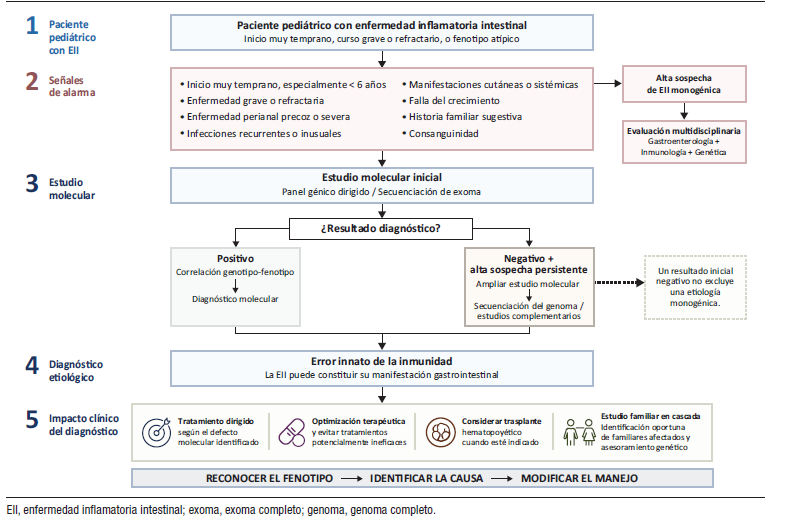
La enfermedad inflamatoria intestinal pediátrica asociada a errores innatos de la inmunidad representa un desafío diagnóstico y terapéutico, en especial en los casos de inicio temprano, enfermedad grave, manifestaciones extraintestinales o refractariedad al tratamiento. Presentamos tres casos pediátricos con un curso clínico agresivo, compromiso multisistémico y respuesta insuficiente a múltiples líneas terapéuticas, en quienes la presencia persistente de señales de alarma motivó la realización de estudios genéticos. En uno de ellos, la secuenciación del exoma identificó una variante patogénica en FOXP3, confirmando el diagnóstico de síndrome IPEX. En los otros dos pacientes, hermanos entre sí, se identificó una alteración en XIAP compatible con diagnóstico de síndrome linfoproliferativo ligado al X tipo 2. En el paciente índice con deficiencia de XIAP, el exoma inicial no identificó variantes causales. Posteriormente, la secuenciación del genoma permitió establecer el diagnóstico molecular, lo que condujo al diagnóstico familiar en cascada de su hermano. Estos casos resaltan la importancia de reconocer tempranamente los fenotipos sugestivos de enfermedad monogénica, mantener la sospecha diagnóstica ante estudios genéticos iniciales negativos y realizar una evaluación multidisciplinaria oportuna. La identificación de un error innato de la inmunidad subyacente puede modificar sustancialmente el abordaje terapéutico, permitir la consideración de opciones potencialmente curativas como el trasplante de progenitores hematopoyéticos y facilitar el asesoramiento genético familiar.
Citas
-1. Poddar U, Aggarwal A, Jayalakshmi K, Sarma MS, Srivastava A, Rawat A, et al. Higher Prevalence of Monogenic Cause Among Very Early Onset Inflammatory Bowel Disease in Children: Experience From a Tertiary Care Center From Northern India. Inflammatory Bowel Diseases. el 3 de octubre de 2023;29(10):1572-8. DOI:10.1093/ibd/izac254
-2. Ouahed J, Spencer E, Kotlarz D, Shouval DS, Kowalik M, Peng K, et al. Very Early Onset Inflammatory Bowel Disease: A Clinical Approach With a Focus on the Role of Genetics and Underlying Immune Deficiencies. Inflammatory Bowel Diseases. el 12 de mayo de 2020;26(6):820-42. DOI:10.1093/ibd/izz259
-3. Arai K. Very Early-Onset Inflammatory Bowel Disease: A Challenging Field for Pediatric Gastroenterologists. Pediatr Gastroenterol Hepatol Nutr. 2020;23(5):411. DOI:10.5223/pghn.2020.23.5.411
-4. Hall CHT, De Zoeten EF. Understanding very early onset inflammatory bowel disease (VEOIBD) in relation to inborn errors of immunity. Immunological Reviews. marzo de 2024;322(1):329-38. DOI:10.1111/imr.13302
-5. Van Rheenen PF, Aloi M, Assa A, Bronsky J, Escher JC, Fagerberg UL, et al. The Medical Management of Paediatric Crohn’s Disease: an ECCO-ESPGHAN Guideline Update. Journal of Crohn’s and Colitis. el 1 de febrero de 2021;15(2):171–94. DOI: 10.1093/ecco-jcc/jjaa161
-6. Chapuy L, Leduc B, Godin D, Damphousse A, Patey N, Dal Soglio D, et al. Phenotype and outcomes of very early onset and early onset inflammatory bowel diseases in a Montreal pediatric cohort. Front Pediatr. el 4 de abril de 2023;11:1157025. DOI:10.3389/fped.2023.1157025
-7. Nambu R, Warner N, Mulder DJ, Kotlarz D, McGovern DPB, Cho J, et al. A Systematic Review of Monogenic Inflammatory Bowel Disease. Clinical Gastroenterology and Hepatology. abril de 2022;20(4):e653-63. DOI:10.1016/j.cgh.2021.03.021
-8. Crowley E, Warner N, Pan J, Khalouei S, Elkadri A, Fiedler K, et al. Prevalence and Clinical Features of Inflammatory Bowel Diseases Associated With Monogenic Variants, Identified by Whole-Exome Sequencing in 1000 Children at a Single Center. Gastroenterology. junio de 2020;158(8):2208-20. DOI: 10.1053/j.gastro.2020.02.023
-9. Baccarella A, Patel T, Conrad MA, Macchi M, Boyer B, Pickering O, et al. Outcomes of Allogeneic Hematopoietic Stem Cell Transplant in Monogenic Inflammatory Bowel Disease. Clinical Gastroenterology and Hepatology. noviembre de 2025;23(12):2242-2252.e4. DOI:10.1016/j.cgh.2025.03.018
-10. Li QQ, Zhang HH, Dai SX. New Insights and Advances in Pathogenesis and Treatment of Very Early Onset Inflammatory Bowel Disease. Front Pediatr. el 1 de marzo de 2022;10:714054. DOI:10.3389/fped.2022.714054
-11. Consonni F, Ciullini Mannurita S, Gambineri E. Atypical Presentations of IPEX: Expect the Unexpected. Front Pediatr. el 5 de febrero de 2021;9:643094. DOI:10.3389/fped.2021.643094
-12. Barzaghi F, Amaya Hernandez LC, Neven B, Ricci S, Kucuk ZY, Bleesing JJ, et al. Long-term follow-up of IPEX syndrome patients after different therapeutic strategies: An international multicenter retrospective study. Journal of Allergy and Clinical Immunology. marzo de 2018;141(3):1036-1049.e5. DOI:10.1016/j.jaci.2017.10.041
-13. Aguilar C, Lenoir C, Lambert N, Bègue B, Brousse N, Canioni D, et al. Characterization of Crohn disease in X-linked inhibitor of apoptosis–deficient male patients and female symptomatic carriers. Journal of Allergy and Clinical Immunology. noviembre de 2014;134(5):1131-1141.e9. DOI:10.1016/j.jaci.2014.04.031
-14. Speckmann C, Lehmberg K, Albert MH, Damgaard RB, Fritsch M, Gyrd-Hansen M, et al. X-linked inhibitor of apoptosis (XIAP) deficiency: The spectrum of presenting manifestations beyond hemophagocytic lymphohistiocytosis. Clinical Immunology. octubre de 2013;149(1):133-41. DOI:10.1016/j.clim.2013.07.004
-15. Kelsen JR, Sullivan KE, Rabizadeh S, Singh N, Snapper S, Elkadri A, et al. North American Society for Pediatric Gastroenterology, Hepatology, and Nutrition Position Paper on the Evaluation and Management for Patients With Very Early-onset Inflammatory Bowel Disease. J pediatr gastroenterol nutr. marzo de 2020;70(3):389-403. DOI:10.1097/MPG.0000000000002567
-16. Charbit-Henrion F, Parlato M, Hanein S, Duclaux-Loras R, Nowak J, Begue B, et al. Diagnostic Yield of Next-generation Sequencing in Very Early-onset Inflammatory Bowel Diseases: A Multicentre Study. Journal of Crohn’s and Colitis. el 29 de agosto de 2018;12(9):1104-12. DOI:10.1093/ecco-jcc/jjy068
-17. Sánchez Hernández DP, Cuadros Mendoza CA, Sammache K, Nieto J, Wilchez Luna A, Ramírez Urrego LC, et al. Enfermedad inflamatoria de inicio muy temprano (VEO-IBD) en Colombia: estudio multicéntrico [Póster]. Póster presentado en: VI Congreso PANCCO y V Congreso Colombiano GECCOL. 2026; Cartagena, Colombia.
-18. Ono S, Takeshita K, Kiridoshi Y, Kato M, Kamiya T, Hoshino A, et al. Hematopoietic Cell Transplantation Rescues Inflammatory Bowel Disease and Dysbiosis of Gut Microbiota in XIAP Deficiency. The Journal of Allergy and Clinical Immunology: In Practice. octubre de 2021;9(10):3767-80. DOI:10.1016/j.jaip.2021.05.045
-19. Marsh RA, Rao K, Satwani P, Lehmberg K, Müller I, Li D, et al. Allogeneic hematopoietic cell transplantation for XIAP deficiency: an international survey reveals poor outcomes. Blood. el 7 de febrero de 2013;121(6):877-83. DOI:10.1182/blood-2012-06-432500
-20. Arnold DE, Nofal R, Wakefield C, Lehmberg K, Wustrau K, Albert MH, et al. Reduced-Intensity/Reduced-Toxicity Conditioning Approaches are Tolerated in XIAP Deficiency but Patients Fare Poorly with Acute GVHD. J Clin Immunol. enero de 2022;42(1):36-45. DOI:10.1007/s10875-021-01103-6
Publicado
Cómo citar
Número
Sección
Licencia
Derechos de autor 2026 Diana Paola Sánchez Hernández, Sara Vallejo Tamayo

Esta obra está bajo una licencia internacional Creative Commons Atribución-NoComercial-CompartirIgual 4.0.


