
Role of Artificial Intelligence in Clinical Research: Methodological Applications and Current Challenges
DOI:
https://doi.org/10.52787/agl.v56i1.619Keywords:
Artificial intelligence, clinical researchAbstract
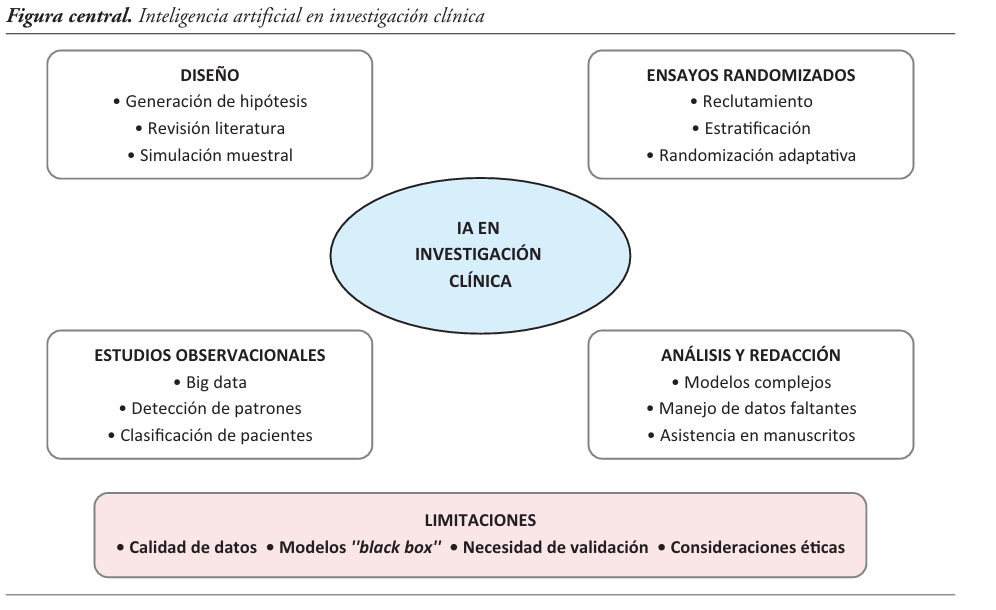
Artificial intelligence (AI) has experienced exponential growth in recent years, driven by the development of machine learning algorithms, increased processing capacity, and the growing availability of large clinical databases.1,2 Its use has expanded into multiple areas of everyday clinical practice.3,4
References
-1. Dalky A, Altawalbih M, Alshanik F, et al. Global Research Trends, Hotspots, Impacts, and Emergence of Artificial Intelligence and Machine Learning in Health and Medicine: A 25-Year Bibliometric Analysis. Healthcare (Basel). 2025 Apr 13;13(8):892.
-2. Kaul V, Enslin S, Gross SA. History of artificial intelligence in medicine. Gastrointest Endosc. 2020;92(4):807-12.
-3. Hunik L, Uijen AA, Kueper JK, et al. The role and utility of artificial intelligence and machine learning for diagnostic prediction in general practice. Eur J Gen Pract. 2026;32(1):2620908.
-4. Bain AP, Ngai D, Bernard PA. Clinical Decision Support Systems in Generalist Practice: Utilizing Clinical Decision Support Systems Tools to Improve Clinical Decisions and Patient Outcomes. Med Clin North Am. 2026;110(2):191-207.
-5. Lin M, Lin L, Lin L, Lin Z, Yan X. A bibliometric analysis of the advance of artificial intelligence in medicine. Front Med (Lausanne). 2025;12:1504428.
-6. Sergi CM, Sesso HD. Artificial Intelligence and the future of clinical trials. Contemp Clin Trials Commun. 2025;47:101545.
-7. Raghupathi W, Raghupathi V. Big data in healthcare and medicine revisited design and managerial challenges in the age of artificial intelligence. Health Inf Sci Syst. 2026;14(1):38.
-8. The integration of artificial intelligence into clinical medicine: Trends, challenges, and future directions. Disease-a-Month. 2025;71(6):101882.
-9. Liu R, Rizzo S, Whipple S, et al. Evaluating eligibility criteria of oncology trials using real-world data and AI. Nature. 2021;592(7855):629-33.
-10. Courvoisier DS, Buitrago-Garcia D, Buclin CP, Bürgisser N, Iudici M, Mongin D. Beyond human gold standards: A multimodel framework for automated abstract classification and information extraction. Res Synth Methods. 2026;17(2):365-77.
-11. Arora A, Arora A. Generative adversarial networks and synthetic patient data: current challenges and future perspectives. Future Healthc J. 2022;9(2):190-3.
-12. Ismail A, Al-Zoubi T, El Naqa I, Saeed H. The role of artificial intelligence in hastening time to recruitment in clinical trials. BJR Open. 2023;5(1):20220023.
-13. Ghim J-L, Ahn S. Transforming clinical trials: the emerging roles of large language models. Transl Clin Pharmacol. 2023;31(3):131-8.
-14. Rosenberger WF, Sverdlov O, Hu F. Adaptive randomization for clinical trials. J Biopharm Stat. 2012;22(4):719-36.
-15. Pablo R-GJ, Roberto D-P, Victor S-U, Isabel G-R, Paul C, Elizabeth O-R. Big data in the healthcare system: a synergy with artificial intelligence and blockchain technology. J Integr Bioinform. 2021;19(1).
-16. Liu M, Li S, Yuan H, Ong MEH, Ning Y, Xie F, Saffari SE, Shang Y, Volovici V, Chakraborty B, Liu N. Handling missing values in healthcare data: A systematic review of deep learning-based imputation techniques. Artif Intell Med. 2023 Aug;142:102587.
-17. Celik SU. Integrating artificial intelligence into scientific writing: a narrative review for clinical and surgical researchers. Am J Surg. 2025;250:116657.
-18. Unveiling the black box: A systematic review of Explainable Artificial Intelligence in medical image analysis. Computational and Structural Biotechnology Journal. 2024;24:542-60.
Downloads
Published
How to Cite
Issue
Section
License
Copyright (c) 2026 Santiago Decotto, Rodolfo Pizarro

This work is licensed under a Creative Commons Attribution-NonCommercial-ShareAlike 4.0 International License.


