
Glucagon-Like Peptide-1 Receptor Agonist and Gastrointestinal Adverse Effects: A Comprehensive Review
DOI:
https://doi.org/10.52787/agl.v56i3.690Keywords:
Glucagon-like peptide-1 receptors, drug-related side effects, nausea, gastroparesis, obesity, diabetesAbstract
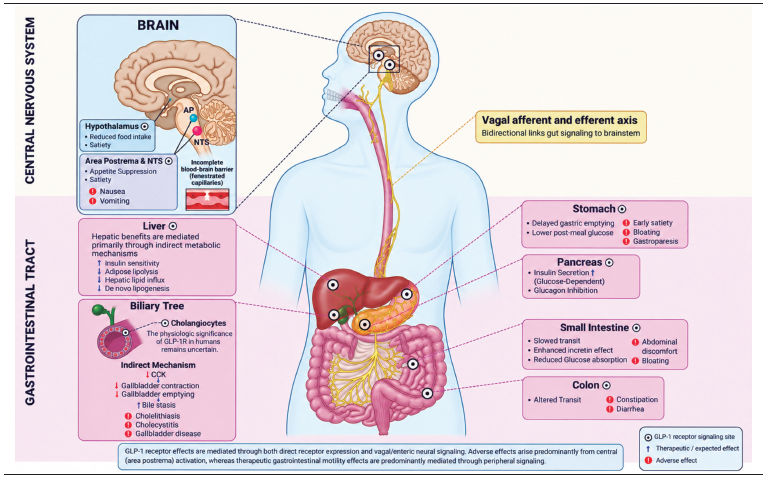
Glucagon-like peptide-1 receptor agonist (GLP-1 RA) has transformed the management of type 2 diabetes and obesity, with expanding indications now spanning cardiovascular, renal, and hepatic disease. As exposure broadens across increasingly diverse populations, gastrointestinal adverse events (GIAEs) have emerged as the dominant tolerability limitation and a leading drug-related reason for discontinuation of treatment. This review synthesizes the mechanisms, clinical spectrum, and management of GLP-1 RA-associated GIAEs. These effects arise from a dual peripheral-central mechanism: peripheral receptor activation slows gastric motility, whereas activation in the area postrema and nucleus tractus solitarius (NTS) drives nausea and emesis. This dual mechanism explains why symptom severity may correlate poorly with the measured degree of gastric-emptying delay and why centrally acting antiemetics are most widely used to relieve nausea and emesis. Across clinical trials, nausea, emesis, diarrhea, constipation, and abdominal pain follow a consistent dose- and indication-dependent gradient, with the highest incidence observed with higher-dose obesity and MASH regimens and multi-agonist molecules. Most symptoms are mild, emerge during dose escalation, and attenuate over time, though a clinically important minority of patients experience persistent symptoms, and a subset develops gastroparesis. Management should rest on anticipation and screening of gastrointestinal symptoms at baseline, pretreatment counseling, gradual up-titration, and dietary measures before pharmacotherapy. Future priorities include standardized motility measurements and endpoints, predictive biomarkers, and evidence-based management algorithms.
References
-1. Ghusn W, Hurtado MD. Glucagon-like Receptor-1 agonists for obesity: Weight loss outcomes, tolerability, side effects, and risks. Obesity Pillars. 2024;12. DOI:10.1016/j.obpill.2024.100127
-2. Zheng Z, Zong Y, Ma Y, et al. Glucagon-like peptide-1 receptor: mechanisms and advances in therapy. Signal Transduct Target Ther. 2024;9(1). DOI:10.1038/S41392-024-01931-Z
-3. NEW INTERPRETATION OF ORAL GLUCOSE TOLERANCE - The Lancet. Accessed June 24, 2026. https://www.thelancet.com/journals/lancet/article/PIIS0140-6736(64)90011-X/fulltext
-4. Aaboe K, Krarup T, Madsbad S, Holst JJ. GLP-1: Physiological effects and potential therapeutic applications. Diabetes Obes Metab. 2008;10(11):994-1003. DOI:10.1111/J.1463-1326.2008.00853.X
-5. Andrews CN, Bharucha AE, Camilleri M, et al. Effects of glucagon-like peptide-1 and sympathetic stimulation on gastric accommodation in humans. Neurogastroenterol Motil. 2007;19(9):716-723. DOI:10.1111/j.1365-2982.2007.00923.x
-6. Jalleh RJ, Marathe CS, Rayner CK, et al. Physiology and Pharmacology of Effects of GLP-1-based Therapies on Gastric, Biliary and Intestinal Motility. Endocrinology. 2024;166(1). DOI:10.1210/endocr/bqae155
-7. Wongjarupong N, Al-Hameed M, Suchartikitwong S, Assavapongpaiboon B, Salehian B. Glucagon-Like Peptide-1 Receptor Agonist Effects on Gastric Motility: A Systematic Review. In: 2020.
-8. Filippatos TD, Panagiotopoulou T V, Elisaf MS. Adverse Effects of GLP-1 Receptor Agonists. Rev Diabet Stud. 2014;11(3-4):202-230. DOI:10.1900/rds.2014.11.202
-9. Smits MM, Van Raalte DH. Safety of Semaglutide. Front Endocrinol (Lausanne). 2021;Volume 12-2021. DOI:10.3389/fendo.2021.645563
-10. Xie X, Yang S, Deng S, Liu Y, Xu Z, He B. Comparative gastrointestinal adverse effects of GLP-1 receptor agonists and multi-target analogs in type 2 diabetes: a Bayesian network meta-analysis. Front Pharmacol. 2025;Volume 16-2025. DOI:10.3389/fphar.2025.1613610
-11. Xu D, Nair A, Sigston C, et al. Potential Roles of Glucagon-Like Peptide 1 Receptor Agonists (GLP-1 RAs) in Nondiabetic Populations. Cardiovasc Ther. 2022;2022:6820377. DOI:10.1155/2022/6820377
-12. Klein KR, Clemmensen KKB, Fong E, Olsen S, Abrahamsen T, Lingvay I. Occurrence of Gastrointestinal Adverse Events Upon GLP-1 Receptor Agonist Initiation With Concomitant Metformin Use: A Post Hoc Analysis of LEADER, STEP 2, SUSTAIN-6, and PIONEER 6. Diabetes Care. 2024;47(2):280-284. DOI:10.2337/dc23-1791
-13. Sanyal AJ, Newsome PN, Kliers I, et al. Phase 3 Trial of Semaglutide in Metabolic Dysfunction–Associated Steatohepatitis. New England Journal of Medicine. 2025;392(21):2089-2099. DOI:10.1056/NEJMoa2413258
-14. Perkovic V, Tuttle KR, Rossing P, et al. Effects of Semaglutide on Chronic Kidney Disease in Patients with Type 2 Diabetes. New England Journal of Medicine. 2024;391(2):109-121. DOI:10.1056/NEJMoa2403347
-15. Yılmaz N, Bastemir M. Gastrointestinal Adverse Effects of GLP-1 and Dual GLP-1/GIP Receptor Agonists: A Comprehensive Update in Diabetic and Obese Populations. Diabetes Metab Syndr Obes. 2026;19:584175. DOI:10.2147/dmso.S584175
-16. Li P, Varghese JS, Shah MK, et al. Prescribing Trends of Glucagon-Like Peptide 1 Receptor Agonists for Type 2 Diabetes or Obesity. JAMA Netw Open. 2025;8(10):e2540890-e2540890. DOI:10.1001/JAMANETWORKOPEN.2025.40890
-17. Berning P, Adhikari R, Schroer AE, et al. Longitudinal Analysis of Obesity Drug Use and Public Awareness. JAMA Netw Open. 2025;8(1):e2457232-e2457232. DOI:10.1001/JAMANETWORKOPEN.2024.57232
-18. Aldhaleei WA, Abegaz TM, Bhagavathula AS. Glucagon-like Peptide-1 Receptor Agonists Associated Gastrointestinal Adverse Events: A Cross-Sectional Analysis of the National Institutes of Health All of Us Cohort. Pharmaceuticals (Basel). 2024;17(2). DOI:10.3390/ph17020199
-19. Jalleh RJ, Talley NJ, Horowitz M, Nauck MA. The science of safety: adverse effects of GLP-1 receptor agonists as glucose-lowering and obesity medications. J Clin Invest. 2026;136.
-20. Fadini GP, Morieri ML, Boscaro C, Bonora BM, Cignarella A. Estimated Oral Semaglutide Exposure Has Distinct Relationships With Glycaemic Response, Weight Loss and Gastrointestinal Tolerability. Diabetes Obes Metab. 2026;28(7):6405-6412. DOI:10.1111/DOM.70840
-21. Ahn CH, Oh TJ, Min SH, Cho YM. Incretin and Pancreatic β-Cell Function in Patients with Type 2 Diabetes. Endocrinol Metab (Seoul). 2023;38(1):1-9. DOI:10.3803/EnM.2023.103
-22. Marathe CS, Rayner CK, Jones KL, Horowitz M. Effects of GLP-1 and incretin-based therapies on gastrointestinal motor function. Exp Diabetes Res. 2011;2011:279530. DOI:10.1155/2011/279530
-23. Thazhath SS, Marathe CS, Wu T, et al. The Glucagon-Like Peptide 1 Receptor Agonist Exenatide Inhibits Small Intestinal Motility, Flow, Transit, and Absorption of Glucose in Healthy Subjects and Patients With Type 2 Diabetes: A Randomized Controlled Trial. Diabetes. 2016;65(1):269-275. DOI:10.2337/db15-0893
-24. Kawatani M, Yamada Y, Kawatani M. Glucagon-like peptide-1 (GLP-1) action in the mouse area postrema neurons. Peptides (NY). 2018;107:68-74. DOI:10.1016/j.peptides.2018.07.010
-25. Turcano P, Savica R, Benarroch E. What Is the Role of Glucagon-Like Peptide 1 Signaling in the Nervous System and Its Potential Neuroprotective Effects? Neurology. 2024;103(4). DOI:10.1212/WNL.0000000000209781
-26. Zhang T, Perkins MH, Chang H, Han W, de Araujo IE. An inter-organ neural circuit for appetite suppression. Cell. 2022;185(14):2478. DOI:10.1016/J.CELL.2022.05.007
-27. Halim MA, Degerblad M, Sundbom M, et al. Glucagon-Like Peptide-1 Inhibits Prandial Gastrointestinal Motility Through Myenteric Neuronal Mechanisms in Humans. J Clin Endocrinol Metab. 2018;103(2):575-585. DOI:10.1210/JC.2017-02006
-28. Lu Z, Yeung CK, Lin G, Yew DTW, Andrews PLR, Rudd JA. Centrally located GLP-1 receptors modulate gastric slow waves and cardiovascular function in ferrets consistent with the induction of nausea. Neuropeptides. 2017;65:28-36. DOI:10.1016/j.npep.2017.04.006
-29. Huang KP, Acosta AA, Ghidewon MY, et al. Dissociable hindbrain GLP1R circuits for satiety and aversion. Nature. 2024;632(8025):585-593. DOI:10.1038/S41586-024-07685-6
-30. Borner T, Geisler CE, Fortin SM, et al. GIP Receptor Agonism Attenuates GLP-1 Receptor Agonist-Induced Nausea and Emesis in Preclinical Models. Diabetes. 2021;70(11):2545-2553. DOI:10.2337/DB21-0459
-31. Ding H, Wang M, Zhang J, et al. Exendin-4 induced retching-like behavior mediated by postsynaptic effect via AMPA receptors in the area postrema of mice. Am J Physiol Endocrinol Metab. 2025;329(2):E254-E265. DOI:10.1152/AJPENDO.00174.2025
-32. Rosen CJ, Ingelfinger JR. GLP-1 Receptor Agonists. N Engl J Med. 2026;394(13):1313-1324. DOI:10.1056/NEJMRA2500106;WGROUP:STRING:MMS
-33. Bellavance D, Chua S, Mashimo H. Gastrointestinal Motility Effects of GLP-1 Receptor Agonists. Curr Gastroenterol Rep. 2025;27(1):49. DOI:10.1007/s11894-025-00995-3
-34. Camilleri M, Carlson P, Dilmaghani S. Prevalence and Variations in Gastric Emptying Delay in Response to GLP-1 Receptor Agonist, Liraglutide. Obesity (Silver Spring). 2023;32(2):232. DOI:10.1002/OBY.23941
-35. Meier JJ, Gallwitz B, Salmen S, et al. Normalization of Glucose Concentrations and Deceleration of Gastric Emptying after Solid Meals during Intravenous Glucagon-Like Peptide 1 in Patients with Type 2 Diabetes. J Clin Endocrinol Metab. 2003;88(6):2719-2725. DOI:10.1210/jc.2003-030049
-36. Gentilella R, Pechtner V, Corcos A, Consoli A. Glucagon-like peptide-1 receptor agonists in type 2 diabetes treatment: are they all the same? Diabetes Metab Res Rev. 2019;35(1):e3070. DOI:10.1002/DMRR.3070;JOURNAL:JOURNAL:10990895;REQUESTEDJOURNAL:JOURNAL:15207560;WGROUP:STRING:PUBLICATION
-37. Chen A, Zhao K, Ceban F, et al. Glucagon-like peptide-1 receptor agonists and gastric emptying time: a systematic review and meta-analysis of prospective studies. Can J Anaesth. 2026;73(4):345-356. DOI:10.1007/S12630-026-03114-6
-38. Quast DR, Schenker N, Menge BA, Nauck MA, Kapitza C, Meier JJ. Effects of Lixisenatide Versus Liraglutide (Short- and Long-Acting GLP-1 Receptor Agonists) on Esophageal and Gastric Function in Patients With Type 2 Diabetes. Diabetes Care. 2020;43(9):2137-2145. DOI:10.2337/DC20-0720
-39. Maselli DB, Camilleri M. Effects of GLP-1 and Its Analogs on Gastric Physiology in Diabetes Mellitus and Obesity. Adv Exp Med Biol. 2021;1307:171-192. DOI:10.1007/5584_2020_496
-40. Lupianez-Merly C, Dilmaghani S, Vosoughi K, Camilleri M. Review article: Pharmacologic management of obesity - updates on approved medications, indications and risks. Aliment Pharmacol Ther. 2024;59(4):475-491. DOI:10.1111/APT.17856;REQUESTEDJOURNAL:JOURNAL:13652036;ISSUE:ISSUE:DOI
-41. Maselli D, Atieh J, Clark MM, et al. Effects of Liraglutide on Gastrointestinal Functions and Weight in Obesity: A Randomized Clinical and Pharmacogenomic Trial. Obesity (Silver Spring). 2022;30(8):1608. DOI:10.1002/OBY.23481
-42. Jalleh RJ, Plummer MP, Marathe CS, et al. Clinical Consequences of Delayed Gastric Emptying With GLP-1 Receptor Agonists and Tirzepatide. J Clin Endocrinol Metab. 2024;110(1):1-15. DOI:10.1210/clinem/dgae719
-43. Jones KL, Huynh LQ, Hatzinikolas S, et al. Exenatide once weekly slows gastric emptying of solids and liquids in healthy, overweight people at steady-state concentrations. Diabetes Obes Metab. 2020;22(5):788-797. DOI:10.1111/DOM.13956;WEBSITE:WEBSITE:DOM-PUBS;WGROUP:STRING:PUBLICATION
-44. Meier JJ, Menge BA, Schenker N, et al. Effects of sequential treatment with lixisenatide, insulin glargine, or their combination on meal-related glycaemic excursions, insulin and glucagon secretion, and gastric emptying in patients with type 2 diabetes. Diabetes Obes Metab. 2020;22(4):599-611. DOI:10.1111/DOM.13935;WEBSITE:WEBSITE:DOM-PUBS;WGROUP:STRING:PUBLICATION
-45. Gorgojo-Martínez JJ, Mezquita-Raya P, Carretero-Gómez J, et al. Clinical Recommendations to Manage Gastrointestinal Adverse Events in Patients Treated with Glp-1 Receptor Agonists: A Multidisciplinary Expert Consensus. J Clin Med. 2022;12(1). DOI:10.3390/jcm12010145
-46. Baumer-Harrison C, Aldaghma D, White AD, et al. GLP-1R biased cAMP agonism maintains glycemic control with reduced malaise and emesis in preclinical mammalian models. Diabetes Obes Metab. 2026;28(3):2317-2328. DOI:10.1111/DOM.70427;JOURNAL:JOURNAL:14631326;WESITE:WEBSITE:DOMPUBS;WGROUP:STRING:PUBLICATION
-47. Herfarth H, Long MD, Hansen JJ, et al. Efficacy and Safety of Liraglutide in Patients With an Ileal Pouch-Anal Anastomosis and Chronic High Bowel Frequency: A Placebo-Controlled, Crossover, Proof-of-Concept Study. Am J Gastroenterol. 2024;119(9):1935-1938. DOI:10.14309/AJG.0000000000002801
-48. May AT, Crowe MS, Blakeney BA, et al. Identification of expression and function of the glucagon-like peptide-1 receptor in colonic smooth muscle. Peptides (NY). 2019;112:48-55. DOI:10.1016/j.peptides.2018.11.007
-49. Wegeberg AML, Hansen CS, Farmer AD, et al. Liraglutide accelerates colonic transit in people with type 1 diabetes and polyneuropathy: A randomised, double-blind, placebo-controlled trial. United European Gastroenterol J. 2020;8(6):695-704. DOI:10.1177/2050640620925968
-50. Cymbal M, Naseem Z, Hoxha D, Garg S. Impact of GLP-1 Receptor Agonists on Whole-Gut Gastrointestinal Motility Using Wireless Motility Capsule: A Descriptive Single-Center Case Series. ACG Case Rep J. 2025;12(8):e01789. DOI:10.14309/crj.0000000000001789
-51. Atieh J, Camilleri M, Halawi H. Mo1813 GLP-1 Receptor Agonists Are Associated With Delayed Colonic Transit: A Propensity Score-Weighted Retrospective Cohort Study. Gastroenterology. 2026;170(6):S-2078. DOI:10.1016/s0016-5085(26)04946-2
-52. Greiner TU, Koh A, Peris E, et al. GLP-1R signaling modulates colonic energy metabolism, goblet cell number and survival in the absence of gut microbiota. Mol Metab. 2024;83. DOI:10.1016/j.molmet.2024.101924
-53. Sun H, Shu J, Tang J, et al. GLP-1 receptor agonists alleviate colonic inflammation by modulating intestinal microbiota and the function of group 3 innate lymphoid cells. Immunology. 2024;172(3):451-468. DOI:10.1111/IMM.13784;SUBPAGE:STRING:FULL
-54. Horowitz M, Aroda VR, Han J, Hardy E, Rayner CK. Upper and/or lower gastrointestinal adverse events with glucagon-like peptide-1 receptor agonists: Incidence and consequences. Diabetes Obes Metab. 2017;19(5):672-681. DOI:10.1111/DOM.12872;CTYPE:STRING:JOURNAL
-55. Chiang CH, Jaroenlapnopparat A, Colak SC, et al. Glucagon-Like Peptide-1 Receptor Agonists and Gastrointestinal Adverse Events: A Systematic Review and Meta-Analysis. Gastroenterology. 2025;169(6):1268-1281. DOI:10.1053/j.gastro.2025.06.003
-56. Kang YM, Punov V, Lim S, Nauck MA. Comparative efficacy and tolerability of currently approved incretin mimetics: A systematic analysis of placebo-controlled clinical trials. Diabetes Obes Metab. 2025;27(7):3736-3746. DOI:10.1111/DOM.16398
-57. Zhang Z, Zhang Q, Tan Y, et al. GLP-1RAs caused gastrointestinal adverse reactions of drug withdrawal: a system review and network meta-analysis. Front Endocrinol (Lausanne). 2023;Volume 14-2023. DOI:10.3389/fendo.2023.1149328
-58. Holman RR, Bethel MA, Mentz RJ, et al. Effects of Once-Weekly Exenatide on Cardiovascular Outcomes in Type 2 Diabetes. New England Journal of Medicine. 2017;377(13):1228-1239. DOI:10.1056/NEJMoa1612917
-59. Halawi H, Khemani D, Eckert D, et al. Effects of liraglutide on weight, satiation, and gastric functions in obesity: a randomised, placebo-controlled pilot trial. Lancet Gastroenterol Hepatol. 2017;2(12):890-899. DOI:10.1016/S2468-1253(17)30285-6
-60. Zinman B, Aroda VR, Buse JB, et al. Efficacy, Safety, and Tolerability of Oral Semaglutide Versus Placebo Added to Insulin With or Without Metformin in Patients With Type 2 Diabetes: The PIONEER 8 Trial. Diabetes Care. 2019;42(12):2262-2271. DOI:10.2337/dc19-0898
-61. Joy B, Ramsamooj A, Ibrahim S, Wen J, Hsu N, Frezza E. Exploring the rates of Gastrointestinal adverse effects among five GLP-1 receptor agonists: A systematic review and Meta-Analysis of randomized controlled trials. Endocrine. 2026;91(1):23. DOI:10.1007/s12020-025-04494-3
-62. Jenkins W, Nassar M, Ghanim H. Gastroparesis Incidence Post-Initiation of Semaglutide Versus Sitagliptin in Type 2 Diabetes: A Retrospective TriNetX Database Analysis. Endocrine Practice. 2024;30(5):S35-S36. DOI:10.1016/j.eprac.2024.03.189
-63. Brown E, Heerspink HJL, Cuthbertson DJ, Wilding JPH. SGLT2 inhibitors and GLP-1 receptor agonists: established and emerging indications. The Lancet. 2021;398(10296):262-276. DOI:10.1016/S0140-6736(21)00536-5
-64. Sun F, Chai S, Yu K, et al. Gastrointestinal adverse events of glucagon-like peptide-1 receptor agonists in patients with type 2 diabetes: a systematic review and network meta-analysis. Diabetes Technol Ther. 2015;17(1):35-42. DOI:10.1089/dia.2014.0188
-65. Rubino D, Abrahamsson N, Davies M, et al. Effect of Continued Weekly Subcutaneous Semaglutide vs Placebo on Weight Loss Maintenance in Adults With Overweight or Obesity: The STEP 4 Randomized Clinical Trial. JAMA. 2021;325(14):1414-1425. DOI:10.1001/jama.2021.3224
-66. Aroda VR, Bain SC, Cariou B, et al. Efficacy and safety of once-weekly semaglutide versus once-daily insulin glargine as add-on to metformin (with or without sulfonylureas) in insulin-naive patients with type 2 diabetes (SUSTAIN 4): a randomised, open-label, parallel-group, multicentre, multinational, phase 3a trial. Lancet Diabetes Endocrinol. 2017;5(5):355-366. DOI:10.1016/S2213-8587(17)30085-2
-67. Aroda VR, Rosenstock J, Terauchi Y, et al. PIONEER 1: Randomized Clinical Trial of the Efficacy and Safety of Oral Semaglutide Monotherapy in Comparison With Placebo in Patients With Type 2 Diabetes. Diabetes Care. 2019;42(9):1724-1732. DOI:10.2337/dc19-0749
-68. Bajaj HS, Welch M, Shah P, et al. Efficacy and safety of retatrutide, a GIP, GLP-1, and glucagon receptor agonist, in people with type 2 diabetes and inadequate glycaemic control with diet and exercise (TRANSCEND-T2D-1): a double-blind, randomised, phase 3 trial. The Lancet. DOI:10.1016/S0140-6736(26)00967-0
-69. Bhattarai HB, Paudel BS, Parajuli SR, et al. Gastrointestinal side effects of the non-peptide GLP-1 receptor agonists: A systematic review and meta-analysis. Medicine. 2025;104(52):e46671. DOI:10.1097/md.0000000000046671
-70. Dahl D, Onishi Y, Norwood P, et al. Effect of Subcutaneous Tirzepatide vs Placebo Added to Titrated Insulin Glargine on Glycemic Control in Patients With Type 2 Diabetes: The SURPASS-5 Randomized Clinical Trial. JAMA. 2022;327(6):534-545. DOI:10.1001/jama.2022.0078
-71. Davies M, Færch L, Jeppesen OK, et al. Semaglutide 2·4 mg once a week in adults with overweight or obesity, and type 2 diabetes (STEP 2): a randomised, double-blind, double-dummy, placebo-controlled, phase 3 trial. The Lancet. 2021;397(10278):971-984. DOI:10.1016/S0140-6736(21)00213-0
-72. Del Prato S, Kahn SE, Pavo I, et al. Tirzepatide versus insulin glargine in type 2 diabetes and increased cardiovascular risk (SURPASS-4): a randomised, open-label, parallel-group, multicentre, phase 3 trial. The Lancet. 2021;398(10313):1811-1824. DOI:10.1016/S0140-6736(21)02188-7
-73. Marso SP, Bain SC, Consoli A, et al. Semaglutide and Cardiovascular Outcomes in Patients with Type 2 Diabetes. New England Journal of Medicine. 2016;375(19):1834-1844. DOI:10.1056/NEJMoa1607141
-74. Wilding JPH, Batterham RL, Calanna S, et al. Once-Weekly Semaglutide in Adults with Overweight or Obesity. New England Journal of Medicine. 2021;384(11):989-1002. DOI:10.1056/NEJMoa2032183
-75. Jastreboff AM, Kaplan LM, Frías JP, et al. Triple-Hormone-Receptor Agonist Retatrutide for Obesity - A Phase 2 Trial. New England Journal of Medicine. 2023;389(6):514-526. DOI:10.1056/NEJMoa2301972
-76. Loomba R, Hartman ML, Lawitz EJ, et al. Tirzepatide for Metabolic Dysfunction–Associated Steatohepatitis with Liver Fibrosis. New England Journal of Medicine. 2024;391(4):299-310. DOI:10.1056/NEJMoa2401943
-77. Wadden TA, Chao AM, Machineni S, et al. Tirzepatide after intensive lifestyle intervention in adults with overweight or obesity: the SURMOUNT-3 phase 3 trial. Nat Med. 2023;29(11):2909-2918. DOI:10.1038/s41591-023-02597-w
-78. Aronne LJ, Sattar N, Horn DB, et al. Continued Treatment With Tirzepatide for Maintenance of Weight Reduction in Adults With Obesity: The SURMOUNT-4 Randomized Clinical Trial. JAMA. 2024;331(1):38-48. DOI:10.1001/jama.2023.24945
-79. Jastreboff AM, Aronne LJ, Ahmad NN, et al. Tirzepatide Once Weekly for the Treatment of Obesity. New England Journal of Medicine. 2022;387(3):205-216. DOI:10.1056/NEJMoa2206038
-80. Wadden TA, Bailey TS, Billings LK, et al. Effect of Subcutaneous Semaglutide vs Placebo as an Adjunct to Intensive Behavioral Therapy on Body Weight in Adults With Overweight or Obesity: The STEP 3 Randomized Clinical Trial. JAMA. 2021;325(14):1403-1413. DOI:10.1001/jama.2021.1831
-81. Sorli C, Harashima S ichi, Tsoukas GM, et al. Efficacy and safety of once-weekly semaglutide monotherapy versus placebo in patients with type 2 diabetes (SUSTAIN 1): a double-blind, randomised, placebo-controlled, parallel-group, multinational, multicentre phase 3a trial. Lancet Diabetes Endocrinol. 2017;5(4):251-260. DOI:10.1016/S2213-8587(17)30013-X
-82. Rosenstock J, Wysham C, Frías JP, et al. Efficacy and safety of a novel dual GIP and GLP-1 receptor agonist tirzepatide in patients with type 2 diabetes (SURPASS-1): a double-blind, randomised, phase 3 trial. The Lancet. 2021;398(10295):143-155. DOI:10.1016/S0140-6736(21)01324-6
-83. Rosenstock J, Allison D, Birkenfeld AL, et al. Effect of Additional Oral Semaglutide vs Sitagliptin on Glycated Hemoglobin in Adults With Type 2 Diabetes Uncontrolled With Metformin Alone or With Sulfonylurea: The PIONEER 3 Randomized Clinical Trial. JAMA. 2019;321(15):1466-1480. DOI:10.1001/jama.2019.2942
-84. Pratley R, Amod A, Hoff ST, et al. Oral semaglutide versus subcutaneous liraglutide and placebo in type 2 diabetes (PIONEER 4): a randomised, double-blind, phase 3a trial. The Lancet. 2019;394(10192):39-50. DOI:10.1016/S0140-6736(19)31271-1
-85. Pi-Sunyer X, Astrup A, Fujioka K, et al. A Randomized, Controlled Trial of 3.0 mg of Liraglutide in Weight Management. New England Journal of Medicine. 2015;373(1):11-22. DOI:10.1056/NEJMoa1411892
-86. Mosenzon O, Blicher TM, Rosenlund S, et al. Efficacy and safety of oral semaglutide in patients with type 2 diabetes and moderate renal impairment (PIONEER 5): a placebo-controlled, randomised, phase 3a trial. Lancet Diabetes Endocrinol. 2019;7(7):515-527. DOI:10.1016/S2213-8587(19)30192-5
-87. Pieber TR, Bode B, Mertens A, et al. Efficacy and safety of oral semaglutide with flexible dose adjustment versus sitagliptin in type 2 diabetes (PIONEER 7): a multicentre, open-label, randomised, phase 3a trial. Lancet Diabetes Endocrinol. 2019;7(7):528-539. DOI:10.1016/S2213-8587(19)30194-9
-88. Nicholls SJ, Pavo I, Bhatt DL, et al. Cardiovascular Outcomes with Tirzepatide versus Dulaglutide in Type 2 Diabetes. New England Journal of Medicine. 2025;393(24):2409-2420. DOI:10.1056/NEJMoa2505928
-89. Newsome PN, Buchholtz K, Cusi K, et al. A Placebo-Controlled Trial of Subcutaneous Semaglutide in Nonalcoholic Steatohepatitis. New England Journal of Medicine. 2021;384(12):1113-1124. DOI:10.1056/NEJMoa2028395
-90. Garvey WT, Frias JP, Jastreboff AM, et al. Tirzepatide once weekly for the treatment of obesity in people with type 2 diabetes (SURMOUNT-2): a double-blind, randomised, multicentre, placebo-controlled, phase 3 trial. The Lancet. 2023;402(10402):613-626. DOI:10.1016/S0140-6736(23)01200-X
-91. Frías JP, Davies MJ, Rosenstock J, et al. Tirzepatide versus Semaglutide Once Weekly in Patients with Type 2 Diabetes. New England Journal of Medicine. 2021;385(6):503-515. DOI:10.1056/NEJMoa2107519
-92. Armstrong MJ, Gaunt P, Aithal GP, et al. Liraglutide safety and efficacy in patients with non-alcoholic steatohepatitis (LEAN): a multicentre, double-blind, randomised, placebo-controlled phase 2 study. Lancet. 2016;387(10019):679-690. DOI:10.1016/s0140-6736(15)00803-x
-93. Liu L, Chen J, Wang L, Chen C, Chen L. Association between different GLP-1 receptor agonists and gastrointestinal adverse reactions: A real-world disproportionality study based on FDA adverse event reporting system database. Front Endocrinol (Lausanne). 2022;13. DOI:10.3389/FENDO.2022.1043789
-94. Gerstein HC, Colhoun HM, Dagenais GR, et al. Dulaglutide and cardiovascular outcomes in type 2 diabetes (REWIND): a doubleblind, randomised placebo-controlled trial. Lancet. 2019;394(10193):121-130. DOI:10.1016/S0140-6736(19)31149-3
-95. Staller K, Neshatian L, Lembo A, Bharucha AE. AGA Clinical Practice Update on Evaluation and Management of Refractory Constipation: Expert Review. Clinical Gastroenterology and Hepatology. 2026;24(2):296-305. DOI:10.1016/j.cgh.2025.09.031
-96. Guo L, Zhang B, Hou J, Zhou Z. Evaluation of Characteristics of Gastrointestinal Adverse Events with Once-Weekly Dulaglutide Treatment in Chinese Patients with Type 2 Diabetes: A Post Hoc Pooled Analysis of Two Randomized Trials. Diabetes Ther. 2020;11(8):1821-1833. DOI:10.1007/s13300-020-00869-z
-97. Abdelrahman RM, Musa TH, Arbab IA, et al. Adverse effects of GLP-1 receptor agonists: Clinical Implications, regulatory perspectives, and future directions. Obes Med. 2026;61:100699. https://doi.org/10.1016/j.obmed.2026.100699
-98. Aldawsari M, Almadani FA, Almuhammadi N, Algabsani S, Alamro Y, Aldhwayan M. The Efficacy of GLP-1 Analogues on Appetite Parameters, Gastric Emptying, Food Preference and Taste Among Adults with Obesity: Systematic Review of Randomized Controlled Trials. Diabetes Metab Syndr Obes. 2023;16:575-595. DOI:10.2147/dmso.S387116
-99. He L, Wang J, Ping F, et al. Association of Glucagon-Like Peptide-1 Receptor Agonist Use With Risk of Gallbladder and Biliary Diseases: A Systematic Review and Meta-analysis of Randomized Clinical Trials. JAMA Intern Med. 2022;182(5):513-519. DOI:10.1001/JAMAINTERNMED.2022.0338
-100. Anderson KL, Feuerstein JD, University AJCET at M. GLP-1RAs increase risk for cholelithiasis and GERD but not other GI or biliary adverse events vs placebo. 2026;179(1). DOI:10.7326/ANNALS-25-05161-JC
-101. Tartaglia E, Bucci T, Rossi M, et al. Risk of all-cause death and pancreatic events following GLP-1 RA initiation in people with obesity or type 2 diabetes: observations from a federated research network. Cardiovasc Diabetol. 2025;24(1). DOI:10.1186/S12933-025-02986-0
-102. Ramírez-Mejía MM, Ponciano-Rodriguez G, Eslam M, Méndez-Sánchez N. GLP-1 receptor agonists and gallbladder disease risk: insights into molecular mechanisms and clinical implications. Ther Adv Endocrinol Metab. 2025;16:20420188251406456. DOI:10.1177/20420188251406456
-103. Bharucha AE, Kudva YC, Prichard DO. Diabetic Gastroparesis. Endocr Rev. 2019;40(5):1318-1352. DOI:10.1210/ER.2018-00161
-104. Bharucha AE, Kudva Y, Basu A, et al. Relationship between glycemic control and gastric emptying in poorly controlled type 2 diabetes. Clinical Gastroenterology and Hepatology. 2015;13(3):466-476.e1. DOI:10.1016/j.cgh.2014.06.034
-105. McGuire DK, Marx N, Mulvagh SL, et al. Oral Semaglutide and Cardiovascular Outcomes in High-Risk Type 2 Diabetes. New England Journal of Medicine. 2025;392(20):2001-2012. DOI:10.1056/NEJMoa2501006
-106. Lincoff AM, Brown-Frandsen K, Colhoun HM, et al. Semaglutide and Cardiovascular Outcomes in Obesity without Diabetes. New England Journal of Medicine. 2023;389(24):2221-2232. DOI:10.1056/NEJMoa2307563
-107. Gao R, Li Y, Li A, Zhou P, Zong H, Li Y. Risk factor screening and prediction modeling of gastrointestinal adverse reactions caused by GLP-1RAs. Front Endocrinol (Lausanne). 2024;15:1502050. DOI:10.3389/FENDO.2024.1502050/BIBTEX
-108. Saha B, Kamalumpundi V, Codipilly DC. GLP1 and GIP Receptor Agonists: Effects on the Gastrointestinal Tract and Management Strategies for Primary Care Physicians. Mayo Clin Proc. 2025;100(12):2228-2236. DOI:10.1016/j.mayocp.2025.09.017
-109. Staller K, Parkman HP, Greer KB, et al. AGA Clinical Practice Guideline on Management of Gastroparesis. Gastroenterology. 2025;169(5):828-861. DOI:10.1053/j.gastro.2025.08.004
-110. Moiz A, Peters TM, Tsoukas MA, Yu OHY, Filion KB, Eisenberg MJ. Balancing the benefits and risks of GLP-1 receptor agonists: a clinical guide for shared decision-making. EClinical Medicine. 2026;96. DOI:10.1016/J.ECLINM.2026.103991
-111. Mehrtash F, Dushay J, Manson JAE. Integrating Diet and Physical Activity When Prescribing GLP-1s-Lifestyle Factors Remain Crucial. JAMA Intern Med. 2025;185(9):1151-1152. DOI:10.1001/JAMAINTERNMED.2025.1794
-112. Kushner RF, Almandoz JP, Rubino DM. Managing Adverse Effects of Incretin-Based Medications for Obesity. JAMA. 2025;334(9):822-823. DOI:10.1001/JAMA.2025.11153
-113. Mozaffarian D, Agarwal M, Aggarwal M, et al. Nutritional priorities to support GLP-1 therapy for obesity: a joint Advisory from the American College of Lifestyle Medicine, the American Society for Nutrition, the Obesity Medicine Association, and The Obesity Society. Am J Clin Nutr. 2025;122(1):344-367. DOI:10.1016/J.AJCNUT.2025.04.023
-114. Moshiree B, Drossman D, Shaukat A. AGA Clinical Practice Update on Evaluation and Management of Belching, Abdominal Bloating, and Distention: Expert Review. Gastroenterology. 2023;165(3):791-800.e3. DOI:10.1053/j.gastro.2023.04.039
-115. Lacy BE, Tack J, Gyawali CP. AGA Clinical Practice Update on Management of Medically Refractory Gastroparesis: Expert Review. Clinical Gastroenterology and Hepatology. 2022;20(3):491-500. DOI:10.1016/j.cgh.2021.10.038
-116. Sun F, Yu K, Yang Z, et al. Impact of GLP-1 receptor agonists on major gastrointestinal disorders for type 2 diabetes mellitus: a mixed treatment comparison meta-analysis. Exp Diabetes Res. 2012;2012:230624. DOI:10.1155/2012/230624
-117. Cummings JL, Atri A, Sano M, et al. Efficacy and safety of oral semaglutide 14 mg (flexible dose) in early-stage symptomatic Alzheimer's disease (evoke and evoke+): two phase 3, randomised, placebo-controlled trials. The Lancet. 2026;407(10544):2167-2179. DOI:10.1016/S0140-6736(26)00459-9
-118. Bonaca MP, Catarig AM, Houlind K, et al. Semaglutide and walking capacity in people with symptomatic peripheral artery disease and type 2 diabetes (STRIDE): a phase 3b, double-blind, randomised, placebo-controlled trial. The Lancet. 2025;405(10489):1580-1593. DOI:10.1016/S0140-6736(25)00509-4
-119. Lähteenvuo M, Tiihonen J, Solismaa A, Tanskanen A, Mittendorfer-Rutz E, Taipale H. Repurposing Semaglutide and Liraglutide for Alcohol Use Disorder. JAMA Psychiatry. 2025;82(1):94-98. DOI:10.1001/JAMAPSYCHIATRY.2024.3599
-120. Rodriguez PJ, Zhang V, Gratzl S, et al. Discontinuation and Reinitiation of Dual-Labeled GLP-1 Receptor Agonists Among US Adults With Overweight or Obesity. JAMA Netw Open. 2025;8(1):e2457349-e2457349. DOI:10.1001/jamanetworkopen.2024.57349
-121. Gonzalez-Rellan MJ, Drucker DJ. New Molecules and Indications for GLP-1 Medicines. JAMA. 2025;334(14):1231-1234. DOI:10.1001/JAMA.2025.14392
-122. Ludvik B, Giorgino F, Jódar E, et al. Once-weekly tirzepatide versus once-daily insulin degludec as add-on to metformin with or without SGLT2 inhibitors in patients with type 2 diabetes (SURPASS-3): a randomised, open-label, parallel-group, phase 3 trial. The Lancet. 2021;398(10300):583-598. DOI:10.1016/S0140-6736(21)01443-4
-123. Hernandez AF, Green JB, Janmohamed S, et al. Albiglutide and cardiovascular outcomes in patients with type 2 diabetes and cardiovascular disease (Harmony Outcomes): a double-blind, randomised placebo-controlled trial. The Lancet. 2018;392(10157):1519-1529. DOI:10.1016/S0140-6736(18)32261-X
-124. Pfeffer MA, Claggett B, Diaz R, et al. Lixisenatide in Patients with Type 2 Diabetes and Acute Coronary Syndrome. New England Journal of Medicine. 2015;373(23):2247-2257. DOI: 10.1056/NEJMoa1509225
-125. Garvey WT, Batterham RL, Bhatta M, et al. Two-year effects of semaglutide in adults with overweight or obesity: the STEP 5 trial. Nature Medicine 2022 28:10. 2022;28(10):2083-2091. DOI:10.1038/s41591-022-02026-4
Published
How to Cite
Issue
Section
License
Copyright (c) 2026 Julio Zúñiga Cisneros, Michael Camilleri, Madhusudan Grover

This work is licensed under a Creative Commons Attribution-NonCommercial-ShareAlike 4.0 International License.


