
Development and Internal Validation of a Predictive Model for Prognostic Response to Proton Pump Inhibitors in Adults with Functional Dyspepsia
DOI:
https://doi.org/10.52787/agl.v54i3.422Keywords:
Functional dyspepsia, proton pump inhibitorsAbstract
Introduction. The response to proton pump inhibitor treatment in functional dyspepsia varies among patients. A decision tool that identifies the probability of response based on clinical data could optimize management in these patients.
Objective. To develop and internally validate an easy-to-use predictive model that enables clinicians to establish the probability of response to proton pump inhibitors in patients with functional dyspepsia.
Material and methods. We conducted a cross-sectional study on adults with functional dyspepsia. A pilot study identified variables related to response to proton pump inhibitors. Internal validation was performed by split-sample method, with 70% for model development and 30% for validation. We developed the model using multivariable logistic regression, and selected variables based on the best subset method. The final model was subsequently transformed into a scoring rule. Predictive ability was assessed using the area under the curve (AUC) and Hosmer-Lemeshow statistic.
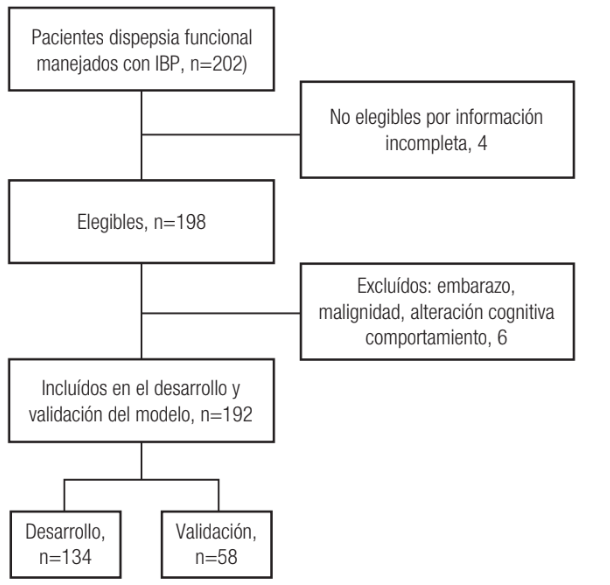
Results. A total of 192 patients were included. The best subset identified 4 variables with the best performance. The logistic model showed good calibration and discrimination with an AUC of 0.89 and a Hosmer-Lemeshow chi-square test with p = 1. The scoring rule assigned the following values: anxiety symptoms (3 points), fibromyalgia (2 points), depression (1 point), and female sex (− 1 point). A total score of 4 points or less was associated with a good response to proton pump inhibitor treatment, with a sensitivity of 96.5% and specificity of 56.6%.
Conclusions. We present a novel tool that facilitates the early identification of patients with a better therapeutic response to the management of functional dyspepsia.
References
-1. Ford AC, Mahadeva S, Carbone MF, Lacy BE, Talley NJ. Functional dyspepsia. The Lancet. 2020;396(10263):1689-702.
-2. Stanghellini V, Chan FKL, Hasler WL, Malagelada JR, Suzuki H, Tack J, et al. Gastroduodenal Disorders. Gastroenterology. 2016;150(6):1380-92.
-3. Aro P, Talley NJ, Agréus L, Johansson SE, Bolling-Sternevald E, Storskrubb T, et al. Functional dyspepsia impairs quality of life in the adult population: Functional dyspepsia and quality of life. Aliment Pharmacol Ther. 2011;33(11):1215-24.
-4. Harer KN, Hasler WL. Functional Dyspepsia: A Review of the Symptoms, Evaluation, and Treatment Options. Gastroenterol Hepatol. 2020;16(2):66-74.
-5. Wauters L, Talley NJ, Walker MM, Tack J, Vanuytsel T. Novel concepts in the pathophysiology and treatment of functional dyspepsia. Gut. 2020;69(3):591-600.
-6. Pinto-Sanchez MI, Yuan Y, Hassan A, Bercik P, Moayyedi P. Proton pump inhibitors for functional dyspepsia. Cochrane Upper GI and Pancreatic Diseases Group, editor. Cochrane Database Syst Rev [Internet]. 21 de noviembre de 2017 [citado 27 de enero de 2019]; Disponible en: http://doi.wiley.com/10.1002/14651858.CD011194.pub3
-7. Nagahara A, Miwa H, Asaoka D, Shimada Y, Sasaki H, Matsumoto K, et al. Pretreatment prediction of symptom response to proton pump inhibitor therapy. J Gastroenterol Hepatol. 2015;30 Suppl 1:25-30.
-8. Hsu YC, Liou JM, Yang TH, Hsu WL, Lin HJ, Wu HT, et al. Proton pump inhibitor versus prokinetic therapy in patients with functional dyspepsia: is therapeutic response predicted by Rome III subgroups? J Gastroenterol. 2011;46(2):183-90.
-9. Bolling-Sternevald E, Lauritsen K, Talley NJ, Junghard O, Glise H. Is it possible to predict treatment response to a proton pump inhibitor in functional dyspepsia? Aliment Pharmacol Ther. 2003;18(1):117-24.
-10. Collins GS, Reitsma JB, Altman DG, Moons KGM. Transparent Reporting of a multivariable prediction model for Individual Prognosis Or Diagnosis (TRIPOD): The TRIPOD Statement. Ann Intern Med. 2015;162(1):55-63.
-11. Wolfe F, Clauw DJ, Fitzcharles MA, Goldenberg DL, Häuser W, Katz RS, et al. Fibromyalgia Criteria and Severity Scales for Clinical and Epidemiological Studies: A Modification of the ACR Preliminary Diagnostic Criteria for Fibromyalgia. J Rheumatol. 2011;38(6):1113-22.
-12. Sullivan LM, Massaro JM, D’Agostino RB. Presentation of multivariate data for clinical use: The Framingham Study risk score functions. Stat Med. 2004;23(10):1631-60.
-13. Kugler TE. [ANXIETY AND DEPRESSIVE DISORDERS IN FUNCTIONAL DYSPEPSIA: CAUSE OR CONSEQUENCE?]. Eksp Klin Gastroenterol Exp Clin Gastroenterol. 2015;(9):29-35.
Published
How to Cite
Issue
Section
License
Copyright (c) 2024 Sebastián Fernando Niño Ramírez, Laura Osorio, Marco Santisteban, Luis Fernando Roldán, Sandra León, Luis Gonzalo Guevara

This work is licensed under a Creative Commons Attribution-NonCommercial-ShareAlike 4.0 International License.


