
Prevalence of Helicobacter pylori and Endoscopic and Histopathological Findings in Obese Patients who are Candidates for Bariatric Surgery
DOI:
https://doi.org/10.52787/agl.v55i4.564Keywords:
Obesity, Helicobacter pylori, upper gastrointestinal endoscopy, bariatric surgery, ArgentinaAbstract
Introduction. The prevalence of Helicobacter pylori in obese patients has been poorly documented, especially in contexts with adequate healthcare access. In these patients, the absence of visible lesions during endoscopy may lead to underestimate relevant histological alterations if systematic biopsies are not performed. There are few local studies characterizing this population, which motivates the need for this research.
Objective. To estimate the prevalence of Helicobacter pylori and to describe the endoscopic and histopathological findings, as well as sociodemographic variables, in obese patients who are candidates for bariatric surgery at the Hospital Universitario Austral.
Materials and methods. Observational, descriptive, cross-sectional, and retrospective study carried out on a cohort of patients who underwent bariatric surgery between 2022 and 2024. Those with complete esophagogastroduodenoscopy and gastric biopsies according to the Sydney protocol were included. Endoscopic findings, histopathological diagnosis, and the presence or absence of H. pylori in the patients were analyzed, stratified by sex and degree of obesity.
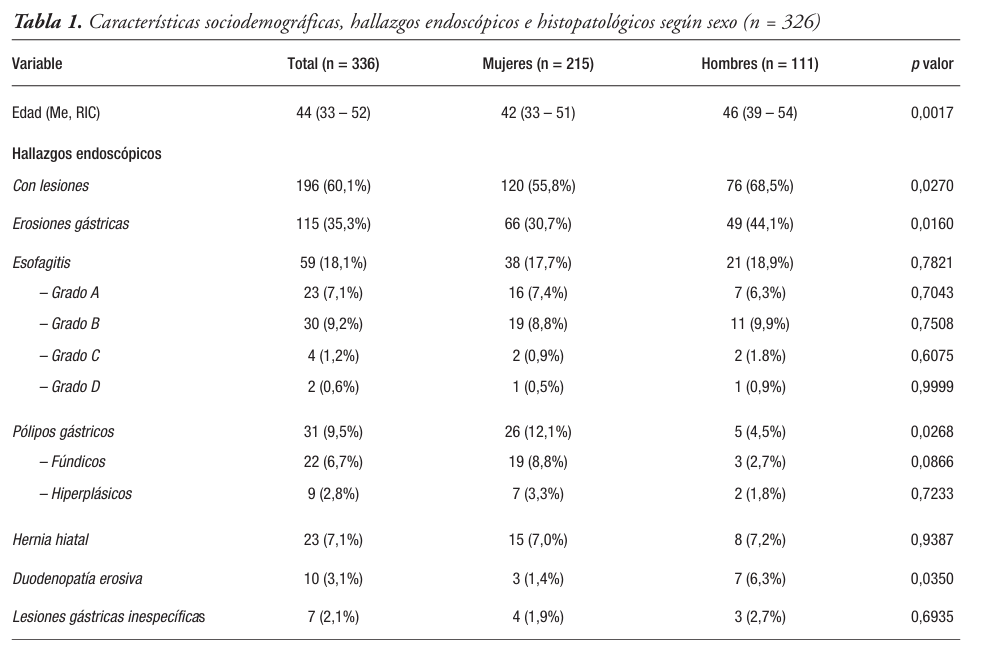
Results. Out of the 418 patients who underwent surgery in our institution, 326 (78%) with esophagogastroduodenoscopy with gastric biopsies were included in the analysis. The rest had esophagogastroduodenoscopy without biopsies, or had not undergone the procedure. Endoscopic lesions were identified in 60.1% of cases, the most frequent being gastric erosions (35.5%) and erosive esophagitis (18.1%). The histopathological analysis revealed chronic gastritis in 55.2% and Helicobacter pylori infection in 21.5%, even in the absence of macroscopic lesions. Significant differences by sex were observed in the prevalence of lesions and histological findings.
Conclusion. The systematic use of biopsies according to Sydney’s protocol allows the identification of relevant histological alterations in obese patients, even in the absence of apparent endoscopic lesions. It is important to perform systematic biopsies during preoperative evaluation to optimize the detection and timely treatment of associated gastrointestinal pathologies.
References
-1. Elmaleh-Sachs A, Schwartz JL, Bramante CT, Nicklas JM, Gudzune KA, Jay M. Obesity management in adults: a review. JAMA. 2023;330(20):2000-15. DOI:10.1001/jama.2023.19897.
-2. Abdallah H, El Skalli M, Mcheimeche H, Casagranda B, De Manzini N, Palmisano S. Indications for upper gastrointestinal endoscopy before bariatric surgery: a multicenter study. Surg Endosc. 2023;37(2):1342-8. DOI:10.1007/s00464-022-09656-2.
-3. García Allende L, Laborda Molteni J, Fuentes N, Tonn EF. Prevalencia de Helicobacter pylori en pacientes obesos sometidos a cirugía bariátrica en un hospital general de Argentina. Acta Gastroenterol Latinoam. 2024;54(2):153-9.
-4. Kim K, Chang Y, Ahn J, et al. Body mass index and risk of intestinal metaplasia: a cohort study. Cancer Epidemiol Biomarkers Prev. 2019;28(4):789-97. DOI:10.1158/1055-9965.EPI-18-0733.
-5. Cai N, Ji GZ, Fan ZN, et al. Association between body mass index and erosive esophagitis: a meta-analysis. World J Gastroenterol. 2012;18(20):2545-55. DOI:10.3748/wjg.v18.i20.2545.
-6. Olmos JA, Ríos H, Higa R; The Argentinean HP Epidemiologic Study Group. Prevalence of Helicobacter pylori infection in Argentina: results of a nationwide epidemiologic study. J Clin Gastroenterol. 2000;31(1):33-7.
-7. Otero Regino W, Otero L, Trespalacios AA. Helicobacter pylori y alteraciones endoscópicas en pacientes con obesidad severa programados para cirugía bariátrica. Rev Colomb Gastroenterol. 2016;30(2):165-70. DOI:10.22516/25007440.36.
-8. Pampillón N, Reynoso C, Solimano M, Sánchez M, Aguirre Ackermann M, De Rosa P, et al. Actualización del Consenso Argentino de Nutrición en Cirugía Bariátrica. Actualiz Nutr. 2016;17(1):19-32.
-9. Lobstein T, Jackson R. World Obesity Atlas 2023. World Obesity Federation; 2023. Disponible en: https://www.worldobesityday.org/assets/downloads/World_Obesity_Atlas_2023_Report.pdf
[Acceso: 1 nov 2025].
-10. Ministerio de Salud de la Nación Argentina. 4ta Encuesta Nacional de Factores de Riesgo – Informe definitivo. Buenos Aires; 2019. Disponible en: https://bancos.salud.gob.ar/sites/default/files/2020-01/4ta-encuesta-nacional-factores-riesgo_2019_informe-definitivo.pdf
[Acceso: 1 nov 2025].
-11. Li Y, Choi H, Leung K, et al. Global prevalence of Helicobacter pylori infection between 1980 and 2022: a systematic review and meta-analysis. Lancet Gastroenterol Hepatol. 2023;8(6):553-64. DOI:10.1016/S2468-1253(23)00070-5.
-12. Laudanno O, Fuentes N, Tonn EF, et al. Optimizing H. pylori eradication in obese patients: the impact of weight-adjusted quadruple therapy. Presented at: Digestive Disease Week (DDW) 2024; Congreso Argentino de Gastroenterología y Hepatología; 2024.
-13. Hp-LATAMReg Study Group. Resultados del registro multicéntrico latinoamericano Hp-LATAMReg: eficacia de las terapias cuádruples sin claritromicina. Congreso GastroLat 2024; Buenos Aires, Argentina. Abstract CONGASTRO2024-047. Disponible en: https://gastrolat.org/congreso2024/congastro2024-047/
[Acceso: 1 nov 2025].
-14. Kamarehei F, Mohammadi Y. The effect of Helicobacter pylori infection on overweight: a systematic review and meta-analysis. Iran J Public Health. 2022;51(11):2417–24. DOI:10.18502/ijph.v51i11.11159.
-15. Parsi M, Zhou QQ, Baidoo L, Jiang Y, et al. Race and gender-based differences in healthcare utilization for common gastrointestinal symptoms among veterans. Am J Gastroenterol. 2024. Disponible en: https://journals.lww.com/ajg/fulltext/2024/10001/S2265_race_and_gender_based_differences_in.2266.aspx
.
-16. Charleston MC, Paredes DGO, Mendez GA, Tello JMC. Development of gastric polyps: 15 years of proton pump inhibitor therapy. Cureus. 2024. Disponible en: https://www.cureus.com/articles/249238-development-of-gastric-polyps-15-years-of-proton-pump-inhibitor-therapy.pdf
.
-17. Inaba T, Yamauchi K, Ishikawa S, Colvin HS. Proton pump inhibitor–induced large gastric polyps can regress within 2 months after discontinuation: experience from two cases. Den Open. 2025;2(1):e70090. DOI:10.1002/deo2.70090.
-18. Schirmer B, Erennoglu C, Miller A. Flexible endoscopy in the management of patients undergoing Roux-en-Y gastric bypass. Obes Surg. 2002;12(5):634-8.
-19. Santos-Grapain S, Galvis-García ES, Herrera-Servín MA, et al. Hallazgos endoscópicos prequirúrgicos en cirugía bariátrica. Rev Colomb Cir. 2020;32(Suppl 2):357-8.
-20. Lim R, Beekley A, Johnson DC, Davis KA. Early and late complications of bariatric operation. Trauma Surg Acute Care Open. 2018;3(1):1-7.
-21. Ministerio de Salud y Desarrollo Social de la Nación. Guía de práctica clínica nacional de obesidad en adultos. Buenos Aires; 2022. Disponible en: https://bancos.salud.gob.ar/recurso/guia-de-practica-clinica-obesidad-en-adultos
[Acceso: 1 nov 2025].
Published
How to Cite
Issue
Section
License
Copyright (c) 2025 Ruby Martinez

This work is licensed under a Creative Commons Attribution-NonCommercial-ShareAlike 4.0 International License.


