
Endoscopic and Therapeutic Profile of Pediatric Patients with Caustic Ingestion: A Seven-Year Experience at a High-Complexity Pediatric Hospital
DOI:
https://doi.org/10.52787/agl.v56i2.629Keywords:
Ingestion of caustic substances, pediatrics, upper gastrointestinal endoscopy, Zargar classification, esophageal stenosis, esophageal dilationAbstract
Introduction. Ingestion of caustic substances in children can cause esophagogastric injuries with significant sequelae, particularly esophageal stenosis. Early upper gastrointestinal endoscopy allows for grading the injury according to the Zargar endoscopic classification and guiding follow-up.
Objective. To describe the endoscopic and therapeutic profile of pediatric patients who ingested caustic substances and were treated between 2018 and 2024 at a referral pediatric hospital.
Materials and Methods. Observational, retrospective, and descriptive study. Patients under 14 years of age who underwent emergency upper gastrointestinal videoendoscopy due to suspected or clinically confirmed ingestion of caustic substances (January 2018–December 2024) were included. Lesions were classified according to the Zargar endoscopic classification (0, I, IIa, IIb, III). Gastric involvement and the need for treatment (dilations, intralesional triamcinolone injection, or surgery) were recorded.
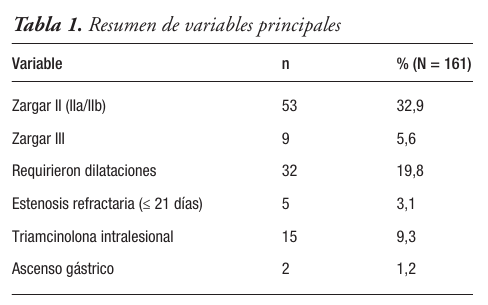
Results. A total of 161 patients were analyzed (mean age: 3 years; 65.8% male). At the initial endoscopy, no lesions were detected in 60 patients (37.3%); Zargar I was observed in 39 (24.2%), Zargar II in 53 (32.9%), and Zargar III in 9 (5.6%). Gastritis was noted in 25 cases (15.5%), mainly in Zargar II–III lesions. Esophageal dilations were required in 32 patients (19.8%): 25/53 (47.2%) with Zargar II lesions and 7/9 (77.8%) with Zargar III lesions. Five patients (3.1%) developed refractory esophageal stenosis (dilation intervals ≤21 days). Fifteen patients received intralesional triamcinolone, although no conclusive benefit was observed in reducing the number of dilation sessions. Two patients (1.2%) required surgical treatment (gastric pull-up).
Conclusions. In this series, Zargar II lesions were the most common among clinically significant injuries and were associated with a substantial need for esophageal dilation. Early endoscopic stratification allows anticipation of the need for intervention and follow-up. In our experience, intralesional triamcinolone did not demonstrate a conclusive benefit.
References
-1. Contini S, Scarpignato C. Caustic injury of the upper gastrointestinal tract: A comprehensive review. World J Gastroenterol. 2013;19(25):3918-3930. DOI:10.3748/wjg.v19.i25.3918.
-2. Betalli P, Falchetti D, Giuliani S, et al. Caustic ingestion in children: is endoscopy always mandatory? J Pediatr Surg. 2008;43(3):532-536.
-3. Mamede RCM, de Mello Filho FV. Ingestion of caustic substances and its complications. Sao Paulo Med J. 2001;119(1):10-15.
-4. European Society for Paediatric Gastroenterology, Hepatology and Nutrition (ESPGHAN). Management of ingested corrosive substances in children. J Pediatr Gastroenterol Nutr. 2017;64(3).
-5. Zargar SA, Kochhar R, Mehta S, Mehta SK. The role of fiberoptic endoscopy in the management of corrosive ingestion and modified endoscopic classification of burns. Gastrointest Endosc. 1991;37(2):165-169.
-6. Anderson KD, Rouse TM, Randolph JG. A controlled trial of corticosteroids in children with corrosive injury of the esophagus. N Engl J Med. 1990;323(10):637-640.
-7. Kochhar R, Ray JD, Sriram PV, et al. Intralesional steroids augment the effects of endoscopic dilation in corrosive esophageal strictures. Gastrointest Endosc. 1999;49(4):509-513.
-8. Repici A, Hassan C, Romeo F, et al. Endoscopic intralesional injection of steroids for refractory benign esophageal strictures: a systematic review. Gastrointest Endosc. 2010;72(3):712-718.
-9. Hashmi SM, Zahid MA, Qureshi MA. Role of intralesional triamcinolone in corrosive esophageal strictures. J Coll Physicians Surg Pak. 2013;23(9):650-653.
-10. Ramasamy K, Gumaste VV. Corrosive ingestion in adults. J Clin Gastroenterol. 2003;37(2):119-124.
Published
How to Cite
Issue
Section
License
Copyright (c) 2026 Karina Arco, Wilma Geraige, Mariana Torres, Paula Roitman, Romina Miranda

This work is licensed under a Creative Commons Attribution-NonCommercial-ShareAlike 4.0 International License.


