
Hemangioendotelioma hepático infantil con elevación de alfa-fetoproteína: reporte de caso y revisión
DOI:
https://doi.org/10.52787/agl.v56i1.523Palabras clave:
Hemangioma hepático, propranolol, tumor vascular, alfa-fetoproteinaResumen
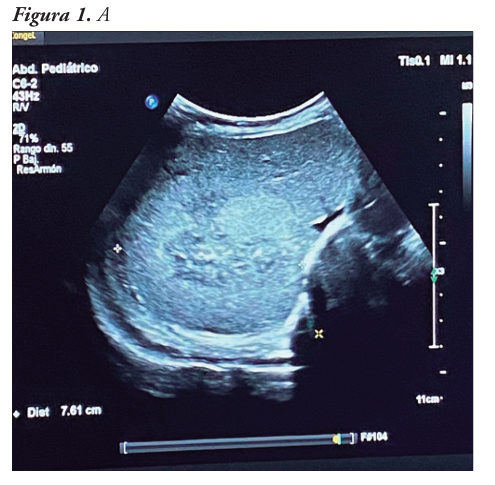
El hemangioendotelioma infantil es el tumor mesenquimatoso benigno más frecuente en el hígado y se presenta habitualmente en los primeros seis meses de vida. Aunque la alfa-fetoproteína sérica es un marcador tumoral de relevancia significativa en casos de hepatoblastoma, carcinoma hepatocelular y tumores de células germinales, en los pacientes con hemangioendotelioma hepático infantil rara vez se observan niveles elevados. En esos casos, dado que los diagnósticos diferenciales tienen pronósticos diferentes, se deben considerar estrategias diagnósticas accesibles con el objetivo de definir conductas. Aún no se ha esclarecido la causa exacta de la elevación de la alfa-fetoproteína en el hemangioendotelioma, si bien en algunos estudios se ha demostrado que los hepatocitos atrapados cerca del tumor son los responsables del aumento de los niveles séricos. En este trabajo describimos un caso clínico de hemangioendotelioma hepático infantil solitario como presentación clínica poco común con elevación de dicho marcador tumoral.
Citas
-1. Sarı N, Yalçın B, Akyüz C, Haliloğlu M, Büyükkapuçku M. Infantile hepatic hemangioendothelioma with elevated serum alpha-fetoprotein. Pediatr Hematol Oncol. 2006;23(8):639-647.
-2. Mazereeuw-Hautier J, Hoeger PH, Benlahrech S, Ammour A, Broue P, Vial J, et al. Efficacy of propranolol in hepatic infantile hemangiomas with diffuse neonatal hemangiomatosis. J Pediatr. 2010;157(2):340-342. doi:10.1016/j.jpeds.2010.04.003.
-3. Hoekstra LT, Bieze M, Erdogan D, Roelofs JJ, Beuers UH, van Gulik TM. Management of giant liver hemangiomas: an update. Expert Rev Gastroenterol Hepatol. 2013;7(3):263-268. doi:10.1586/EGH.13.10.
-4. Itinteang T, Chibnall AM, Marsh R, Dunne JC, de Jong S, Davis PF, et al. Elevated serum levels of alpha-fetoprotein in patients with infantile hemangioma are not derived from within the tumor. Front Surg. 2016;3:5. doi:10.3389/fsurg.2016.00005.
-5. Kim TJ, Lee YS, Song YS, Park CK, Shim SI, Kang CS, et al. Infantile hemangioendothelioma with elevated serum α-fetoprotein: report of 2 cases with immunohistochemical analysis. Hum Pathol. 2010;41(5):763-767. doi:10.1016/j.humpath.2009.05.019.
-6. Kacała A, Dorochowicz M, Matus I, Puła M, Korbecki A, Sobański M, et al. Hepatic hemangioma: review of imaging and therapeutic strategies. Medicina (Kaunas). 2024;60(3):449. doi:10.3390/medicina60030449.
-7. Fuchs J, Warmann SW, Urla C, Schäfer JF, Schmidt A. Management of benign liver tumors. Semin Pediatr Surg. 2020;29(5):150941. doi:10.1016/j.sempedsurg.2020.150941.
-8. Kim EH, Koh KN, Park M, Kim BE, Im HJ, Seo JJ. Clinical features of infantile hepatic hemangioendothelioma. Korean J Pediatr. 2011;54(6):260-266.
Publicado
Cómo citar
Número
Sección
Licencia
Derechos de autor 2026 María Laura Valberdi Lecce, María Cristina Arregui, Carmen Lucía Otegui Banno, Andrea Besga

Esta obra está bajo una licencia internacional Creative Commons Atribución-NoComercial-CompartirIgual 4.0.


