
Semaglutida y enfermedad hepática grasa asociada a disfunción metabólica: una revisión sistemática
DOI:
https://doi.org/10.52787/agl.v56i1.591Palabras clave:
Enfermedad hepática grasa asociada a disfunción metabólica, esteatohepatitis asociada a disfunción metabólica, semaglutidaResumen
Introducción. La enfermedad hepática grasa asociada a disfunción metabólica (MAFLD) y la esteatohepatitis asociada a disfunción metabólica (MASH) presentan una elevada prevalencia y constituyen un importante problema de salud pública.
Objetivo. Realizar una revisión sistemática actualizada de ensayos clínicos aleatorizados que evaluaron el impacto de la semaglutida en los desenlaces hepáticos en pacientes con MAFLD/MASH.
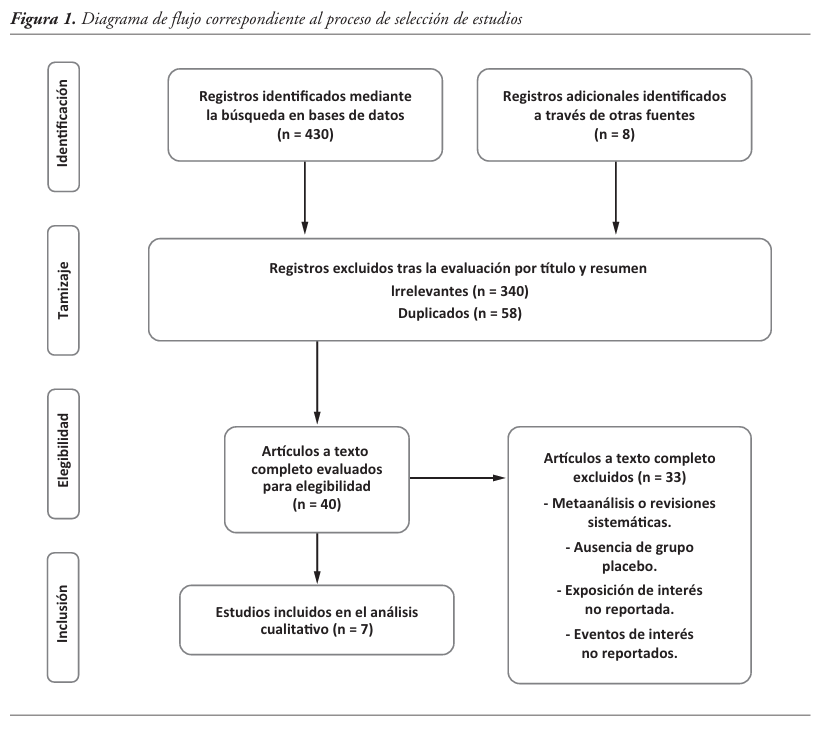
Materiales y métodos. Se efectuó una búsqueda sistemática en la literatura de acuerdo con las guías PRISMA. Se incluyeron ensayos clínicos aleatorizados, controlados con placebo, que evaluaron el efecto de la semaglutida sobre desenlaces hepáticos en pacientes con MAFLD/MASH, utilizando parámetros histológicos y/o métodos de diagnóstico por imágenes.
Resultados. Los estudios analizados sugieren un beneficio de la semaglutida frente al placebo en los desenlaces hepáticos. En cuanto al evento resolución de la MASH sin empeoramiento de la fibrosis, observamos concordancia entre los estudios que incluyeron biopsia hepática. Al evaluar la mejoría de la fibrosis sin empeoramiento de la MASH, los resultados no fueron uniformes. Los estudios que evaluaron imágenes mostraron un beneficio consistente de la semaglutida sobre la esteatosis hepática. Sin embargo, los estudios no lograron demostrar cambios significativos en la rigidez hepática. Diferencias en el tamaño muestral, el tiempo de seguimiento y las poblaciones analizadas podrían explicar estas discrepancias.
Conclusión. El uso de semaglutida en pacientes con MAFLD/MASH se asoció con mejoras en variables relacionadas con la esteatosis y, en menor medida, con cambios en marcadores de fibrosis. Estos hallazgos deberán confirmarse en estudios de mayor envergadura y con mayores tiempos de seguimiento.
Citas
-1. Younossi ZM, Kalligeros M, Henry L. Epidemiology of metabolic dysfunction-associated steatotic liver disease. Clin Mol Hepatol. 2025;31(Suppl):S32-S50. doi:10.3350/cmh.2024.0431.
-2. Basil B, Myke-Mbata BK, Eze OE, Akubue AU. From adiposity to steatosis: metabolic dysfunction-associated steatotic liver disease, a hepatic expression of metabolic syndrome - current insights and future directions. Clin Diabetes Endocrinol. 2024;10(1):39. doi:10.1186/s40842-024-00187-4.
-3. Quek J, Chan KE, Wong ZY, Tan C, Tan B, Lim WH, et al. Global prevalence of non-alcoholic fatty liver disease and non-alcoholic steatohepatitis in the overweight and obese population: a systematic review and meta-analysis. Lancet Gastroenterol Hepatol. 2023;8:20-30. doi:10.1016/S2468-1253(22)00317-X.
-4. Cho EE, Ang CZ, Quek J, Fu CE, Lim LKE, Heng ZEQ, et al. Global prevalence of non-alcoholic fatty liver disease in type 2 diabetes mellitus: an updated systematic review and meta-analysis. Gut. 2023;72(11):2138-2148. doi:10.1136/gutjnl-2023-330110.
-5. Marso SP, Bain SC, Consoli A, Eliaschewitz FG, Jódar E, Leiter LA, et al. Semaglutide and cardiovascular outcomes in patients with type 2 diabetes. N Engl J Med. 2016;375:1834-1844. doi:10.1056/NEJMoa1607141.
-6. Gouveri E, Popovic DS, Papanas N. Potential new therapeutic implications of semaglutide: new colours of the rainbow? Diabetes Ther. 2024;15(1):13-18. doi:10.1007/s13300-02301506-1.
-7. Amaro A, Sugimoto D, Wharton S. Efficacy and safety of semaglutide for weight management: evidence from the STEP program. Postgrad Med. 2022;134(sup1):5-17. doi:10.1080/00325481.2022.2147326.
-8. Lincoff AM, Brown-Frandsen K, Colhoun HM, Deanfield J, Emerson SS, Esbjerg S, et al. Semaglutide and cardiovascular outcomes in obesity without diabetes. N Engl J Med. 2023;389(24):2221-2232. doi:10.1056/NEJMoa2307563.
-9. Targher G, Byrne CD, Tilg H. MASLD: a systemic metabolic disorder with cardiovascular and malignant complications. Gut. 2024;73(4):691-702. doi:10.1136/gutjnl-2023-330595.
-10. Newsome PN, Buchholtz K, Cusi K, Linder M, Okanoue T, Ratziu V, et al. A placebo-controlled trial of subcutaneous semaglutide in nonalcoholic steatohepatitis. N Engl J Med. 2021;384(12):1113-1124. doi:10.1056/NEJMoa2028395.
-11. Flint A, Andersen G, Hockings P, Johansson L, Morsing A, Palle MS, et al. Randomised clinical trial: semaglutide versus placebo reduced liver steatosis but not liver stiffness in subjects with non-alcoholic fatty liver disease assessed by magnetic resonance imaging. Aliment Pharmacol Ther. 2021;54(9):1150-1161. doi:10.1111/apt.16608.
-12. Loomba R, Abdelmalek MF, Armstrong MJ, Jara M, Kjær MS, Krarup N, et al. Semaglutide 2.4 mg once weekly in patients with non-alcoholic steatohepatitis-related cirrhosis: a randomised, placebo-controlled phase 2 trial. Lancet Gastroenterol Hepatol. 2023;8(6):511-522. doi:10.1016/S2468-1253(23)00068-7.
-13. Ratziu V, Francque S, Behling CA, Cejvanovic V, Cortez-Pinto H, Iyer JS, et al. Artificial intelligence scoring of liver biopsies in a phase II trial of semaglutide in nonalcoholic steatohepatitis. Hepatology. 2024;80(1):173-185. doi:10.1097/HEP.0000000000000723.
-14. Schattenberg J, Grønbæk H, Kliers I, Ladelund S, Long MT, Nygård SB, et al. Proteomic signatures reflect effects of semaglutide treatment for MASH. JHEP Rep. 2025;7(10):101521. doi:10.1016/j.jhepr.2025.101521.
-15. Sanyal AJ, Newsome PN, Kliers I, Østergaard LH, Long MT, Kjær MS, et al. Phase 3 trial of semaglutide in metabolic dysfunction–associated steatohepatitis. N Engl J Med. 2025;392(21):2089-2099. doi:10.1056/NEJMoa241325.
-16. Golub IS, Manubolu VS, Aldana-Bitar J, Dahal S, Verghese D, Alalawi L, et al. The impact of semaglutide on liver fat assessed by serial cardiac CT scans in patients with type 2 diabetes: results from STOP trial. Nutr Metab Cardiovasc Dis. 2025;35(9):104036. doi:10.1016/j.numecd.2025.104036.
-17. Bandyopadhyay S, Das S, Samajdar SS, Joshi SR. Role of semaglutide in the treatment of nonalcoholic fatty liver disease or non-alcoholic steatohepatitis: a systematic review and meta-analysis. Diabetes Metab Syndr. 2023;17(10):102849. doi:10.1016/j.dsx.2023.102849.
-18. Mantovani A, Morandin R, Fiorio V, Lando MG, Stefan N, Tilg H, et al. Glucagon-like peptide-1 receptor agonists improve MASH and liver fibrosis: a meta-analysis of randomised controlled trials. Liver Int. 2025;45(9):e70256. doi:10.1111/liv.70256.
-19. Wang Y, Zhou Y, Wang Z, Ni Y, Prud'homme GJ, Wang Q. Efficacy of GLP-1-based therapies on metabolic dysfunction-associated steatotic liver disease and metabolic dysfunction-associated steatohepatitis: a systematic review and meta-analysis. J Clin Endocrinol Metab. 2025;110(10):2964-2979. doi:10.1210/clinem/dgaf336.
-20. Fang L, Li J, Zeng H, Liu J. Effects of GLP-1 receptor agonists on the degree of liver fibrosis and CRP in non-alcoholic fatty liver disease and non-alcoholic steatohepatitis: a systematic review and meta-analysis. Prim Care Diabetes. 2024;18(3):268-276. doi:10.1016/j.pcd.2024.03.005.
-21. Arya S, Kaji AH, Boermeester MA. PRISMA reporting guidelines for meta-analyses and systematic reviews. JAMA Surg. 2021;156:789-790. doi:10.1001/jamasurg.2021.0546.
-22. Sterne JAC, Savovic J, Page MJ, Elbers RG, Blencowe NS, Boutron I, et al. RoB 2: a revised tool for assessing risk of bias in randomised trials. BMJ. 2019;366:l4898. doi:10.1136/bmj.l4898.
-23. Alfawaz S, Burzangi A, Esmat A. Mechanisms of non-alcoholic fatty liver disease and beneficial effects of semaglutide: a review. Cureus. 2024;16(8):e67080. doi:10.7759/cureus.67080.
-24. Genua I, Cusi K. Approaches to nonalcoholic fatty liver disease: current and future therapies. Diabetes Spectr. 2024;37(1):48-58. doi:10.2337/dsi23-0012.
-25. Nogueira JP, Cusi K. Role of insulin resistance in the development of nonalcoholic fatty liver disease in people with type 2 diabetes: from bench to patient care. Diabetes Spectr. 2024;37(1):20-28. doi:10.2337/dsi23-0013.
-26. Vergès B, Duvillard L, Pais de Barros JP, Bouillet B, Baillot-Rudoni S, Rouland A, et al. Liraglutide increases the catabolism of apolipoprotein B100-containing lipoproteins in patients with type 2 diabetes and reduces proprotein convertase subtilisin/kexin type 9 expression. Diabetes Care. 2021;44(4):1027-1037. doi:10.2337/dc20-1843.
-27. Patel Chavez C, Cusi K, Kadiyala S. The emerging role of glucagon-like peptide-1 receptor agonists for the management of NAFLD. J Clin Endocrinol Metab. 2022;107(1):29-38. doi:10.1210/clinem/dgab578.
-28. Al-Qaaneh AM, Qunaibi EA, Al-Fraihat NA, Abu-Aisheh BE, Rabea S, Al Aloul AA, et al. Real-world off-label use of semaglutide for weight reduction: user behavior, effectiveness, and satisfaction. Patient Prefer Adherence. 2025;19:3373-3385. doi:10.2147/PPA.S549716.
-29. Duan Y, Pan X, Luo J, Xiao X, Li J, Bestman L, et al. Association of inflammatory cytokines with non-alcoholic fatty liver disease. Front Immunol. 2022;13:880298. doi:10.3389/fimmu.2022.880298.
-30. Masson W, Lobo M, Nogueira JP, Rodriguez-Granillo AM, Barbagelata LE, Siniawski D. Anti-inflammatory effect of semaglutide: updated systematic review and meta-analysis. Front Cardiovasc Med. 2024;11:1379189. doi:10.3389/fcvm.2024.1379189.
-31. Yang XD, Yang YY. Clinical pharmacokinetics of semaglutide: a systematic review. Drug Des Devel Ther. 2024;18:2555-2570. doi:10.2147/DDDT.S470826.
-32. Tang A, Desai A, Hamilton G, Wolfson T, Gamst AC, Lam J, et al. MRI and MRE for non-invasive quantitative assessment of hepatic steatosis and fibrosis in NAFLD and NASH: clinical trials to clinical practice. Nat Rev Gastroenterol Hepatol. 2022;19(5):341-359. doi:10.1016/j.jhep.2016.06.005.
-33. Arai T, Atsukawa M, Tsubota A, Ono H, Kawano T, Yoshida Y, et al. Efficacy and safety of oral semaglutide in patients with non-alcoholic fatty liver disease complicated by type 2 diabetes mellitus: a pilot study. JGH Open. 2022;6(7):503-511. doi:10.1002/jgh3.12780.
-34. Volpe S, Lisco G, Fanelli M, Racaniello D, Colaianni V, Triggiani D, et al. Once-weekly subcutaneous semaglutide improves fatty liver disease in patients with type 2 diabetes: a 52-week prospective real-life study. Nutrients. 2022;14(21):4673. doi:10.3390/nu14214673.
-35. Carretero-Gómez J, Carrasco-Sánchez FJ, Fernández-Rodríguez JM, Casado-Escribano P, Miramontes-González JP, Seguí-Ripoll JM, et al. Effect of semaglutide on fatty liver disease biomarkers in patients with diabetes and obesity. Rev Clin Esp (Barc). 2023;223(3):134-143. doi:10.1016/j.rceng.2022.12.001.
-36. Alkhouri N, Herring R, Kabler H, Kayali Z, Hassanein T, Kohli A, et al. Safety and efficacy of combination therapy with semaglutide, cilofexor and firsocostat in patients with non-alcoholic steatohepatitis: a randomised, open-label phase II trial. J Hepatol. 2022;77(3):607-618. doi:10.1016/j.jhep.2022.04.003.
-37. Romero-Gómez M, Lawitz E, Shankar RR, Chaudhri E, Liu J, Lam RLH, et al. A phase IIa active-comparator-controlled study to evaluate the efficacy and safety of efinopegdutide in patients with non-alcoholic fatty liver disease. J Hepatol. 2023;79(4):888-897. doi:10.1016/j.jhep.2023.05.013.
Publicado
Cómo citar
Número
Sección
Licencia
Derechos de autor 2026 Walter Masson, Carla Solís, Juan Patricio Nogueira

Esta obra está bajo una licencia internacional Creative Commons Atribución-NoComercial-CompartirIgual 4.0.


