
Prevalence of Rumination Syndrome: Experience in Three Countries of the Working Group on Brain-Gut Disorders of the Latin American Society of Pediatric Gastroenterology, Hepatology and Nutrition (LASPGHAN)
DOI:
https://doi.org/10.52787/agl.v55i4.526Keywords:
Rumination syndrome, prevalence, association, Rome IV, Latin AmericaAbstract
Introduction. According to Rome IV diagnostic criteria, the worldwide prevalence of rumination syndrome is 1.0%.
Objectives. Identify the prevalence and possible associations of rumination syndrome in preschoolers, schoolchildren, and adolescents from Colombia, Mexico, and Ecuador according to Rome IV criteria.
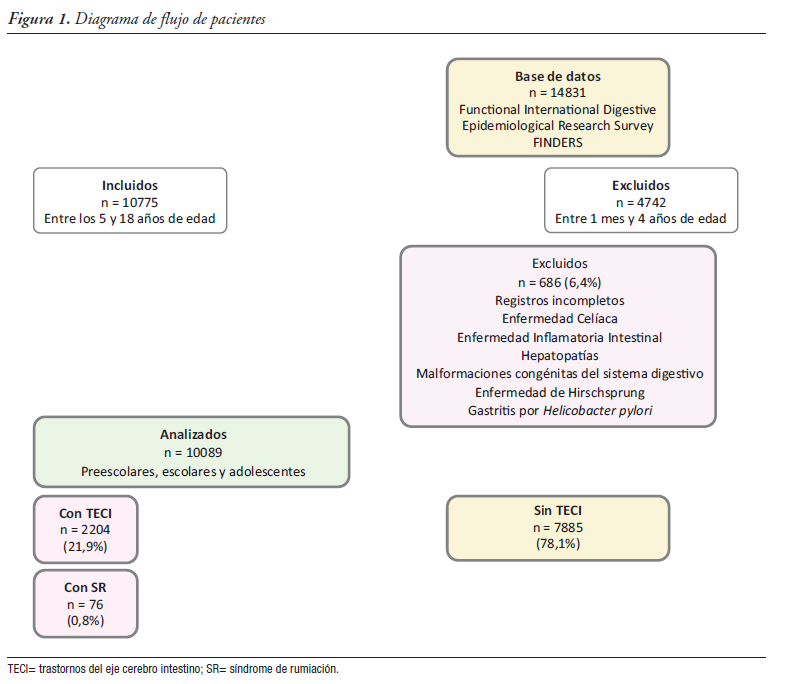
Materials and methods. Prospective, observational, cross-sectional and descriptive study conducted in three Latin American countries. We included children and adolescents between 5 and 18 years of age from the Functional International Digestive Epidemiological Research Survey - FINDERS Group database, who answered the Rome IV Pediatric Digestive Symptom Questionnaire in Spanish. Sociodemographic, family, clinical, and nutritional variables were analyzed. The statistical analysis included measures of central tendency and dispersion for univariate description of the variables. Subsequently, bivariate analyses were performed using the chi-square or Fisher’s exact tests, and odds ratios (OR) were calculated with their respective 95% confidence intervals. A p-value of p < 0.05 was considered statistically significant.
Results. A total of 10,089 children (mean age 12.7 ± 3.1 years; 55.6% female; 52.1% mixed race) were included in the study. Rumination syndrome was diagnosed in 0.8% of the children. An overlap of rumination with other functional disorders was observed in 3.4% of cases. The following variables were associated with rumination: female gender (OR = 2.10; 95% CI: 1.24 - 3.66; p = 0.0032) and overlap with other functional disorders such as constipation and aerophagia (p = 0.000).
Conclusion. The prevalence of rumination syndrome among preschoolers, schoolchildren, and adolescents in three Latin American countries is similar to that reported worldwide. Bivariate analysis showed an association with female sex and overlap with other functional disorders.
References
-1. Hyams JS, Di Lorenzo C, Saps M, Shulman RJ, Staiano AM, Van Tilburg M. Childhood Functional Gastrointestinal Disorders: Child/Adolescent. Gastroenterology. 2016;150:1456-68.
-2. Velasco-Benítez CA, Collazos-Saa LI, García-Perdomo HA. A systematic review and meta-analysis in schoolchildren and adolescents with functional gastrointestinal disorders according to Rome IV criteria. Arq Gastroenterol. 2022;59(2):304-13.
-3. Cinquetti M, Biasin M, Ventimiglia M, Balanzoni L, Signorelli D, Pietrobelli A. Functional gastrointestinal disorders, lifestyle habits, and smartphone addiction in adolescents. Pediatr Med Chir. 2021;43(1).
-4. Saps M, Velasco-Benítez CA, Langshaw AH, Ramírez-Hernández CR. Prevalence of functional gastrointestinal disorders in children and adolescents: Comparison between Rome III and Rome IV criteria. J Pediatr. 2018;199:212-6.
-5. Robin SG, Keller C, Zwiener R, Hyman PE, Nurko S, Saps M, et al. Prevalence of pediatric functional gastrointestinal disorders utilizing the Rome IV criteria. J Pediatr. 2018;195:134-9.
-6. Plasencia J, Ponce L, Alvarez J, Fragoso T, Arias YI, Carassou M, et al. Desórdenes gastrointestinales funcionales en adolescentes de la enseñanza preuniversitaria. Rev Cuba Med Mil. 2024;53(3).
-7. Haworth JJ, Treadway S, Hobson AR. The prevalence of rumination syndrome and rumination disorder: A systematic review and meta-analysis. Neurogastroenterol Motil. 2024;36(7):e14793.
-8. Altamimi E, Scarpato E, Saleh I, Tantawi K, Alassaf M, Ijam M, et al. National prevalence of functional gastrointestinal disorders in Jordanian children. Clin Exp Gastroenterol. 2020;13:267-72.
-9. Murray HB, Thomas JJ, Hinz A, Munsch S, Hilbert A. Prevalence in primary school youth of pica and rumination behavior: The understudied feeding disorders. Int J Eat Disord. 2018;51(8):994-8.
-10. Josefsson A, Hreinsson JP, Simrén M, Tack J, Bangdiwala SI, Sperber AD, et al. Global Prevalence and Impact of Rumination Syndrome. Gastroenterology. 2022;162(3):731-42.e9.
-11. Zand M, Jones MP, Halland M, Herrick L, Choung RS, Saito YA, et al. Prevalence, symptoms and risk factor profile of rumination syndrome and functional dyspepsia: a population-based study. Aliment Pharmacol Ther. 2021;54(11-12):1416-31.
-12. Jia MR, Lu PL, Khoo JS, Sabella J, Yang DM, Puri NB, et al. Delay in diagnosis is associated with decreased treatment effectiveness in children with rumination syndrome. J Pediatr Gastroenterol Nutr. 2024;79(4):850-4.
-13. Alioto A, Di Lorenzo C, Montgomery ML, Yacob D. High cost and low yield: The diagnostic evaluation of rumination syndrome in pediatrics. J Pediatr. 2017;185:155-9.
-14. Righini F, Aspirot A, Faure C. High-resolution esophageal manometry patterns in children and adolescents with rumination syndrome. J Pediatr Gastroenterol Nutr. 2017;65(6):627-32.
Published
How to Cite
Issue
Section
License
Copyright (c) 2025 Carlos Alberto Velasco-Benítez, Estefanía Rodríguez-López, Daniela Alejandra Velasco-Suárez, Claudia Jimena Ortiz-Rivera, Edgar Játiva-Mariño, Ada Ruth Dionicio Avendaño, Arony Martínez

This work is licensed under a Creative Commons Attribution-NonCommercial-ShareAlike 4.0 International License.


